Thornborough Henges

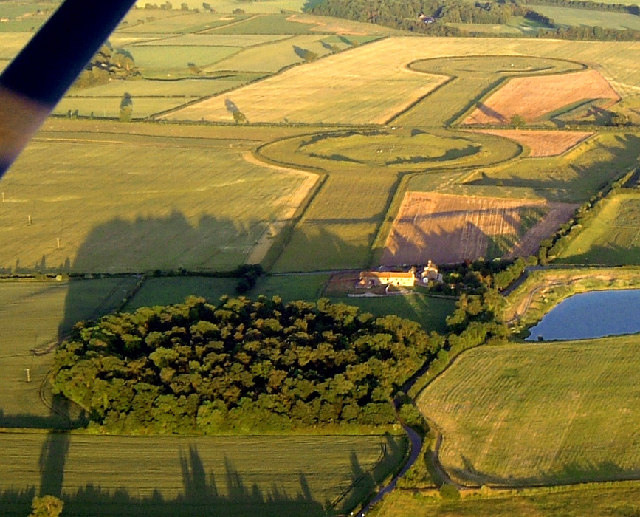
The Thornborough Henges in North Yorkshire are a set of three huge circular henges, each around 250m in diameter, spaced out by about 500m on an approximate northwest-southeast alignment. They date from between 3500 and 2500 BC.


Looking south (the nearest henge is wooded!). Image via wikimedia.

What stands out to me about the henges?

They’re very big! They were built with a bank maybe 4 metres tall around them, and inside the bank a flat space and then a ditch around the flat Central area. Apparently they had 700 people there one recent Beltane!

With the banks at full height you’d only see the sky from within, no hills on the horizon. The banks were apparently faced with white gypsum. I wonder if they posted people or symbols or lights on the bank marking the stars rising and other astronomical events?


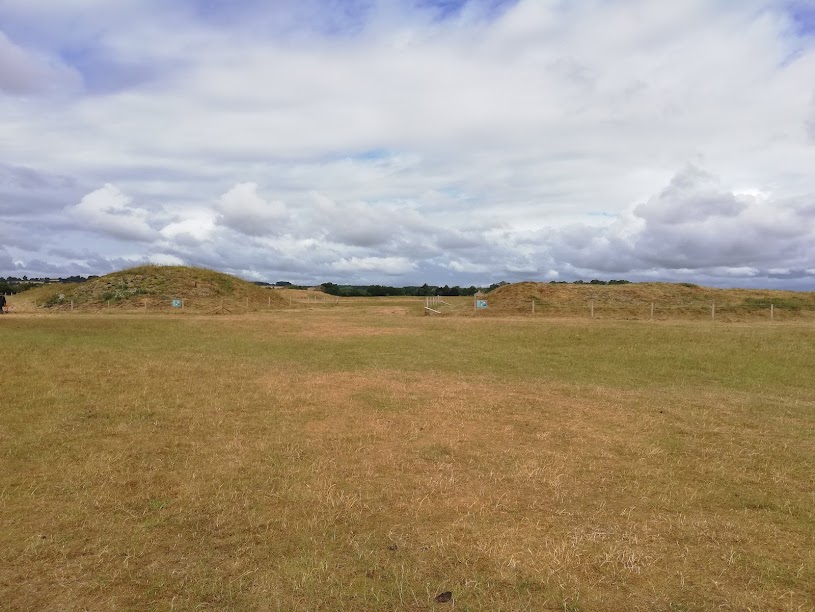
At the entrance to the central henge, with the wooded henge in the background.
From my visit in Summer 2025.

Orion


The three henges are not quite in a straight line, but seem to have the same alignment as the three stars of Orion’s belt. Also, before the henges were built there was a straight cursus (or ditch) dug at right angles to the line of henges, and passing through the central ring. It was roughly pointed towards where Orion would set in the West at the start of autumn. The cursus would have been cut through the trees, so maybe it was a sight line?


By Till Credner via Wikimedia

Is this apparent alignment with Orion a coincidence? Well other sites might have similar alignments. According to Sigurd Towrie, there are sites on Orkney that might have a similar mirroring of the belt-stars. There’s also a (controversial) theory that the pyramids in Egypt align with the belt.

What might Orion have meant to stone age people? Personally it’s my favorite winter constellation – easy to spot even in London, and somehow a comforting presence on clear winter nights.  Perhaps to them it was a marker of the season, or perhaps a reminder of something more. Sigurd Towrie’s article also discusses Stonehenge, and the theory that it may be associated with a mid-winter healing deity. Did Orion represent this ancient prehistoric god? A deity who presided over the darkest time of the year?

I recommend a visit to Thornborough Henges – especially on a clear winter’s night!

Impression of Thornborough Henges ca 2,500BC
by Peter Dunn.

The Diamond Mirror and the Four Worlds – Part 3, The Dragon World

In previous articles I’ve talked about the Familiar World and the Elemental World. Now it’s time for the Dragon World!

In mythology, dragons are powerful creatures, much bigger and more powerful than people. They can be symbols of impersonal energies, which may be outside or inside of us. How can we deal with these energies?

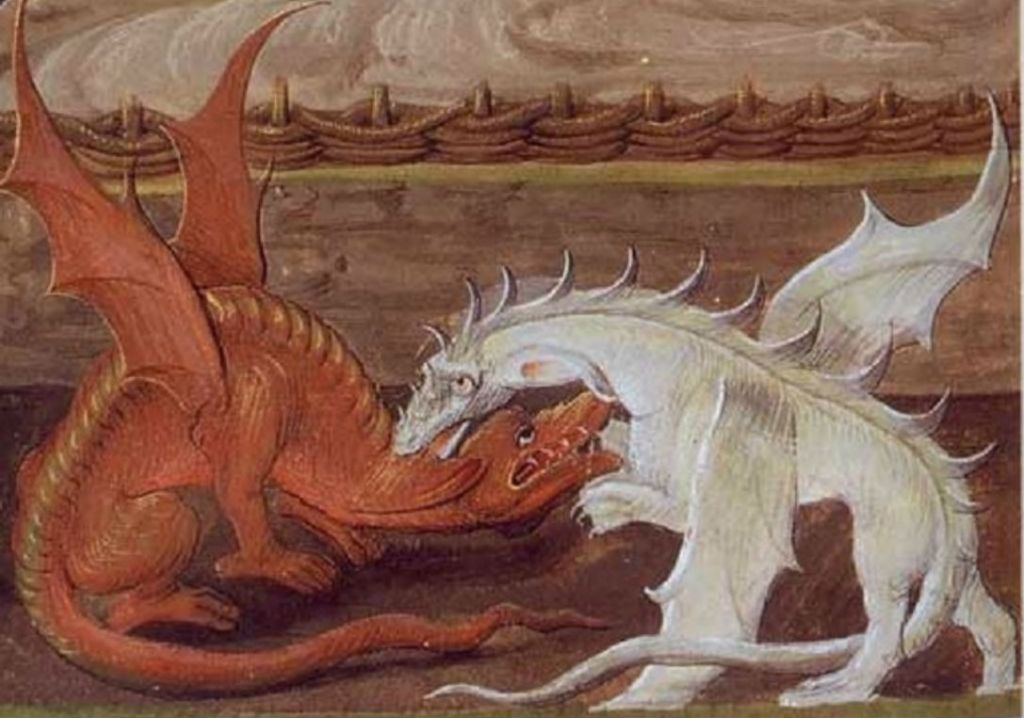
The story of Lludd and Llevelys in the Mabinogion tells of a plague caused by fighting dragons “The second plague was a shriek which came on every May-eve, over every hearth in the Island of Britain. And this went through people’s hearts, and so seared them, that the men lost their hue and their strength, and the women their children, and the young men and the maidens lost their senses, and all the animals and trees and the earth and the waters, were left barren.” King Lludd finds a way to make the dragons sleep, so they can be buried in the earth in Dinas Emrys, where they protect the kingdom. Later on, in another story, the young Merlin reveals the hiding place of the dragons.

Cropped image of the Two Dragons at Dinas Emrys from History of the Kings of Britain by Geoffrey of Monmouth – Public Domain

Dragons in Us

The Dragon World corresponds to the level of true thought (or abstract thought) on the Diamond Mirror. This is a level of mind that we’re not usually aware of, although we sometimes see the results in a flow of inspiration, or in solving a difficult problem. A characteristic is the enthusiastic rush of energy from the dragon’s passing.

We need protection from the dragon’s power, which can be destructive, and within us there is a natural guard, a sentinel, which keeps us safe. We can leave food for the dragons on the threshold, and they can do us favours in return. It is also possible by carefully setting aside our own preoccupations to ride a dragon. This can be a symbol of mastery of impersonal energies.

Dealing with the Abstract

When I try to solve a difficult problem, I often start by working in the realm of association and meaning, perhaps reading about it, or talking it over with someone. Then sometime it helps if I leave it to the ‘subconscious’ to work on it. I might make a cup of tea, go for a walk, or sleep on it. Later on, I often find the solution is ready. I’m not really aware of the process itself.

An example of this problem-solving method was the way that the German chemist Kekulé worked out the structure of the benzene molecule. After thinking about it without success, its ring shape came to him after he had a dream of a snake seizing its own tail, the ancient symbol called the Ouroboros.

Benzene molecule and Ouroboros

Poetic Inspiration

“… poetry is composed at the back of the mind; an unaccountable product of a trance in which the emotions of love, fear, anger, or grief are profoundly engaged, though at the same time powerfully disciplined.”
– Robert Graves in his Oxford Addresses on Poetry (1962)

In Welsh mythology, the inspiration of the bards is called awen. It’s described in The Book of Taliesin as proceeding mysteriously from a cauldron:

ban pan doeth peir
ogyrwen awen teir

“the three elements of inspiration that came, splendid, out of the cauldron”.

The word ‘peir’ (cauldron) can also mean ‘sovereign’ often with the broad meaning of God or the Divine. In either case, the mystery is that inspiration seems to come from the unseen realms.

Modern Druid symbol for Awen, the flowing inspiration

Entering the Dragon World

I think it’s possible to be more aware of the dragon world by leaving behind our sense of ‘I’. This can happen in meditation, where we learn to step over a threshold. It’s like going through a gate that protects one world from another, so that the sense of ‘I’ doesn’t get overwhelmed by deeper processes, and deeper processes are not interfered with by the sense of ‘I’.

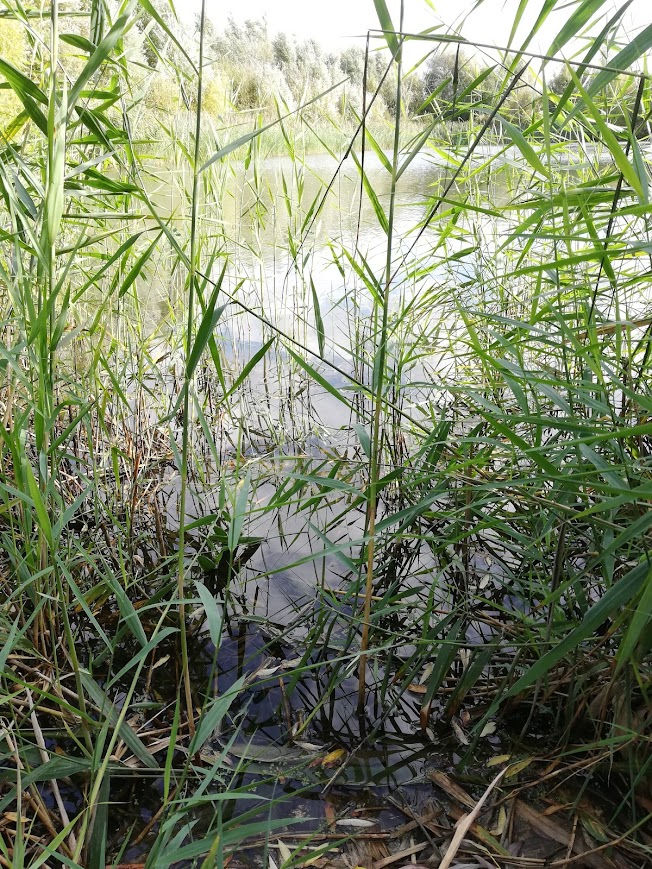
I’m sitting on the lakeshore in amongst the reeds. I want to listen to the reeds, so I sit there quietly and try to pay attention. As time goes by I become aware of something unusual going on – there is a sense of communication taking place, although it doesn’t feel like ‘me’ doing the communicating. I picture it as the spirit of the reeds talking directly with my spirit – some larger part of myself that I’m not normally aware of. It is communicating with the reed, and I am just picking up on the backwash of this exchange. It is quite frightening to feel that something is going on in me that I’m not in control of. It would be easy to switch off, or to let the fear take over, but I try to keep with the experience and just keep the awareness of that strange conversation that seems to be taking place.

The Dragon of Radnor Forest

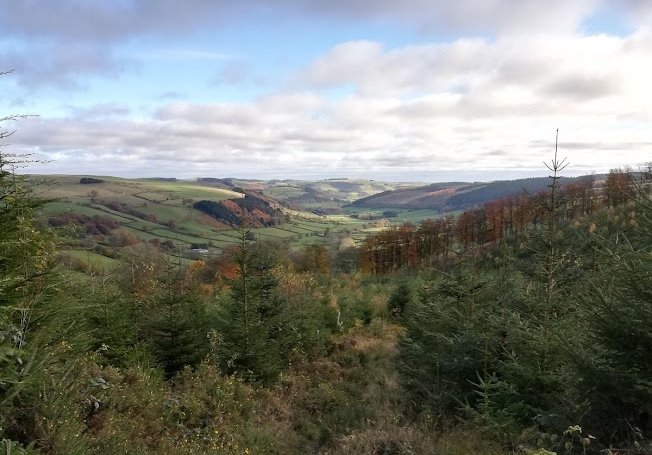
View from Radnor Forest

The Dragon and the St Michael Churches

In legend, Radnor forest is the place of the last dragon in Wales, and it sleeps. Roundabout the forest are five St Michael Churches which supposedly control or contain the dragon. All are built on ancient mounds and surrounded by yew trees. They are (anticlockwise):

Cascob (North-East)- It’s near where John Dee’s family came from (see below), and a magic spell was found in the churchyard and now hangs in the church. There’s also a special fluted yew tree there.

Cascob Church

Rhydithon (North) – on the A488, didn’t seem too interesting. https://www.jlb2011.co.uk/walespic/churches/llanfihangelrhyd1.htm

Cefnllys (North-West), near Llandidrod Wells, now isolated without any road access – https://www.britainexpress.com/wales/mid/llanfihangel-cefnllys-church.htm

Nant Melan (South), near the A44. It was handed to the Knights of St John, and is built on the same plan as Kilpeck Church in Herefordshire. https://cpat.org.uk/Archive/churches/radnor/16855.htm

Discoed (East) has a very ancient yew tree, dated at 5000 years old. I want to visit it! https://www.britainexpress.com/wales/mid/discoed-st-michael.htm

John Dee

As mentioned above, John Dee has a connection with Cascob Church. See also https://www.radnorfforest.co.uk/news-views/legands which says

The Welsh grandfather of Elizabeth I’s advisor, Dr. John Dee, purchased the estate of Nantygroes which Dr. Dee continued to maintain and visit. Nantygroes is relatively close to Llanfihangel Cascob, as the crow flies. It’s interesting to note that ”Dee claimed descent from Llewelyn Crugeryr, a thirteenth-century chieftain whose Castell Crugeryr mound can still be seen by the A44 just west of the Fforest Inn.” (The Folklore of Radnorshire © Roy Palmer 2001, pg. 105; Logaston Press 2007).

Nant-y-Groes is in the Lugg River valley on the B4356 near Pilleth. See https://coflein.gov.uk/en/site/30849/

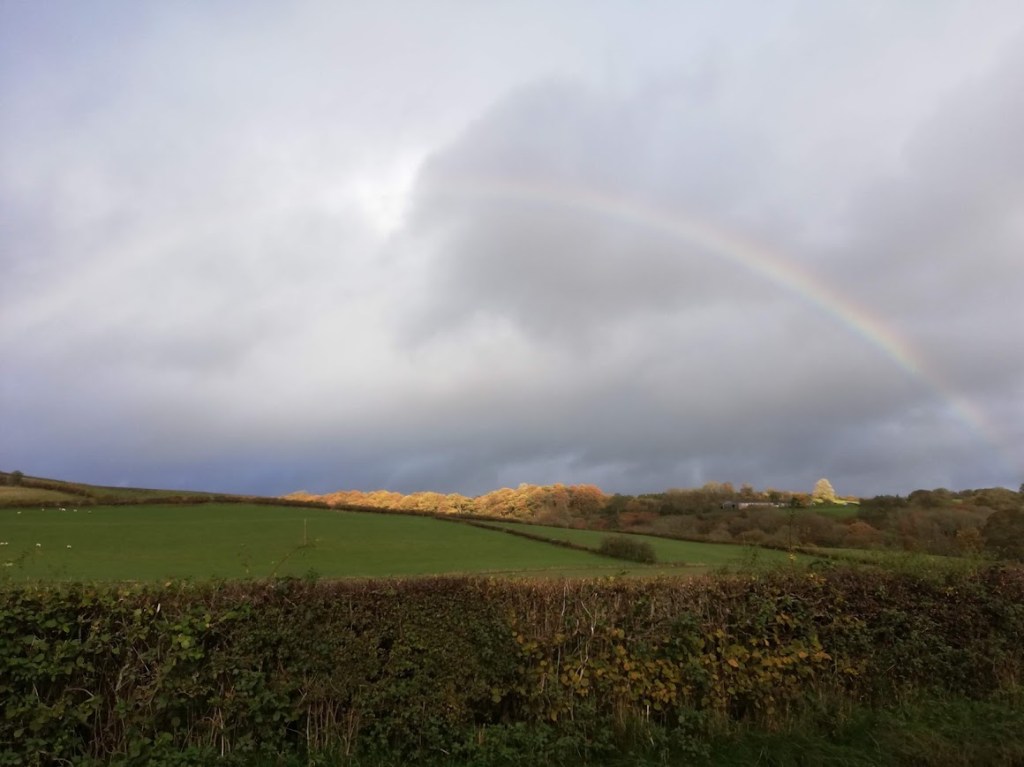
Here’s a picture of a rainbow over the hill behind Nantygroes:

Walton Basin Area

The Walton Basin is on the south east side of Radnor Forest (around Evenjobb), and there was a lot going on in this area in the Neolithic period, including the largest prehistoric timber enclosure in Britain!
https://cpat.org.uk/wp-content/uploads/2018/12/How-the-West-was-Won-Panel-1.pdf

Particular items include:

Hindwell Enclosure Timber Circle

This large timber enclosure was just south of Evenjobb. Nothing to see now I don’t think, but the road pattern follows the outline of the (huge) enclosure.
https://www.megalithic.co.uk/article.php?sid=19715

Four Stones Circle

This is a nice little circle of four stones, just inside a field by the road.
https://www.megalithic.co.uk/article.php?sid=349

Four Stones Circle

Whimble Hill and the Mystery Hill!

There is a barrow, 19m in diameter and 1.2m high, set upon Whimble, a conical hill, and it has a more recent cairn, 11m in diameter and 0.6m high, superimposed upon it.
https://www.megalithic.co.uk/article.php?sid=34221

Now… There’s a hill which dominates the view from the East. Here’s a picture taken from the road through Evenjobb, showing a rounded hill poking up in Radnor Forest. It seems significant that is overlooks the whole of the basin. Is it Whimble Hill? What do you think? Whatever it is it make me think the dragon is somewhere there! I want to explore there some more!

Mystery Hill from Evenjobb

The House of Llyr

by Ligia Luckhurst

The task of the House of Llyr is to make the unfamiliar familiar, and the familiar strange.

The House is where Llyr is person because nothing can be, except through a person and as a person. The House is where he may be approached in person by other persons.

Llyr

In Welsh, Llyr is called: Llŷr Llediaith, meaning “half-speech”or “half-language”, “speaking with a foreign accent” (Wikipedia).

Llyr is form-bestowing: delimiting the limitless so that there can be this or that. A limit is a shared boundary, however, and any form Llyr bestows is also the form of Llyr as he does so. That is why Llyr is known as a shapeshifter, forever in motion, unsteady, groundless, never uttering the final word, yet uttering one anyway, with a foreign accent, as he streams shaping the fields of appearance but never stopping to become a field of being.

Measure-bestowing, Llyr is himself without measure, unseen and undisclosed by what he discloses.

Any imparting of form is an arrest – a bringing to a rest. Any arrest is violence. Any violence is traumatic to a greater or lesser degree, and met by resentment and resistance. Partaking of the boundary he imposes, Llyr resents and resists himself. That is why there is no peace in the House of Llyr.

Committing violence, as well as being at its receiving end, can lead to enjoyment of negativity. Enjoyment comes from that part of our actions which is in excess of what is necessary. Llyr can thus be unnecessarily cruel.

Llyr in mythology

Llyr is born of the Lord of Waters and the Lady of the Fields of Space. Enticed by dreamers, he rises wherever air and water meet. It is an ever-changing boundary, incessant movement – a shimmer caught by the corner of an eye, or the wild rage of a storm.

Ler or Lir means “sea” in Old Irish which was very different from Middle and Modern Irish: the sea in Irish appears as “an fharraige” in Google translator, or yet “muir” as in “muir Eireann” (the Irish Sea). “Ler” is here the nominative form, and “Lir” the genitive one (“He is Ler” and “I see Lir”). He is thus (the god of) the sea, and he is thus because, in mythical times, there cannot be a sea that is just a body of water: it is always also that which makes water be water to us.

What is the shape of the ocean, what is its true form? Is it the shape of the vessel that holds it, as is often said of all water? The shape of the ocean basin? With each tiny wave – or a huge one – it changes in every instant; a fuzz of shapes that only acquires a stable form on a map, which is but their imaginary average. Not only that, but the shape of the vessel – the ocean basin – is not stable: the movement of water wears the rock of the shore here and washes sand onto it there. And what of the surface of the ocean, unlimited by any shoreline? What is the shape of that? Not only does it move, but also evaporates all the time wherever it meets the air. The shape of the sea, even if it could be accurately recorded in an infinitesimally brief moment, would not last beyond that moment. It would change immediately and never in all eternity return to its previous form. That is why the sea and its father the ocean are, in mythology and psychology, associated with dreams and the unconscious which can never fully be the case, and belong, at least partly, to the Otherworld. In our dreams, we can interact with the dead. In many mythologies, the journey to the Otherworld, which is also the World of the Dead, involves crossing a large body of water.

In the Mabinogion, Llyr is the father of Bran, Branwen, and Manawydan by his spouse, Penarddun. He is imprisoned by Euroswydd, who then marries Penarddun. Two sons issue from this marriage: Nisien and Efnisien, Nisien being the good brother and Efnisien the bad one. This looks very much like the replacement of the old Bronze Age gods by human heroes, ushering the age of Law and responsibility and therefore direction, destiny and meaning into the Garden of Eternal Return which revolves by itself.

Llyr withdraws behind the screen of his children: in Irish mythology, like in the Welsh one, he does not feature much in stories, and the attributes of the sea god are mostly given to his son Manannan, also known as the God of the Otherworld (Emain Ablach). Like his seldom mentioned father, Manannan is a shape-shifter and comes to women, sometimes, in the shape of a sea-bird or heron, and sometimes in the shape of their own husband.

The “Children of Lir” (Irish: Oidheadh Chloinne Lir) is a tale from the post-Christianisation period in which Lir’s children – four of them, not three, and bearing different names from their Welsh counterparts – are transformed into swans by their jealous stepmother Aoife. She gets punished to spend the rest of her life as a loathsome demon of the air, but Lir’s children must spend three hundred years as swans on Loch Dairbhreach, where Lir contemplates them, listening to their song and speech. The swans then move to the ocean to spend another three hundred years on Sruth na Maoilé, and the final three hundred at Inis Gluairé, suffering terribly from darkness, rain and cold.

At the end of their allotted period of torment, the swans return to their father’s abode, only to find it abandoned and overgrown. (Here, as in Welsh mythology, Lir/Llyr withdraws, cold, morose, remote and shockingly uninterested, even forgetful, of his children’s undeserved fate.)

Finally, at their wit’s end, the swans seek refuge with a Christian saint, St Mochaomhog, on Inis Gluaire. He binds them with silver chains and they do not resist (silver being the metal associated with Lir). They are coveted by the King of Connacht’s wife, but the saint refuses to hand them over. Angered, the King grabs them to snatch them away, but, at the instant of his touch, they turn into withered, emaciated old people and die, having requested and received Baptism by the saint.

The Willow and the Crane

The crane is sacred to Llyr/Lir whose son Mananan keeps his magical objects, or the treasures of Ireland, in a crane skin bag. Eating cranes was taboo in Ireland and was considered unhealthy in Britain. The crane robs a warrior of his courage and announces death. It represents the warrior’s anima in her spiteful, peevish, malicious hag aspect.

Further afield, the crane is sacred to Hermes/Mercury in his role as guide to the Land of the Dead and inventor of the alphabet, much in the same way as the ibis, a bird from the crane family, belongs to the Egyptian god of writing and wisdom, Thoth.

By means of letters, the crane brings treasures over from their Otherworldly – transcendental – state into earthly manifest reality as knowledge. Letters are here the form which directs the movement of the treasure-substance.

The willow is associated with water and the moon. Willow is one of the nine woods used for the Beltane fire. Among them, it represents the tree of death.

The medicinal properties of the willow are numerous. Its bark contains salicin which forms the active ingredient in aspirin.

In Roman mythology, the willow is sacred to Minerva, the goddess of wisdom, who invented numbers. In Greece, it is associated with Orpheus who carried willow branches on his journey through the Underworld. Like the crane, the willow provides the means of bringing forth the hidden treasure of the Otherworld and making it manifest as knowledge: number, sound, song. But – again, like the crane – the willow is associated with the unstable, the illicit and the fey. Willow trees stalk travellers at night, muttering at them. Lovers who live together outside wedlock are said to have been married round the willow tree. One can use willow twigs to conceal one’s smell from large carnivores – to mask one’s identity.

Spring Equinox at Arbor Low

This year I spent the spring equinox with friends in Derbyshire, visiting two of the stone circles from the Bull Tor triangle. The journey between these circles and the exercises carried out at each of them are the subject of the book The Dancing Circles (see an earlier article here). This time we visited Arbor Low and Eyam Moor Stone Circle, and I have a little bit to say about our time at Arbor Low.

Arbor Low Stone Circle by Graham Hogg, via Wikimedia Commons

Thursday was unusually warm and sunny, but approaching Arbor Low in the morning there was a white haze blanketing the hills, like a cocoon under which spring was being prepared. The trees were beginning to bud, and crocuses were in flower in the circle itself. Sky larks were trilling in the air above us.

The exercise for Arbor Low aims to still the mind, and consists of visualising the sun’s progress through the sky from sunrise to sunset, taking about ten minutes for the entire imaginary arc. The equinox is a good day to do this exercise, because the sun rises due east, sets due west, and rises to a point due south of the zenith at noon. This arch of course extends under the earth, where the sun travels at night, making a circle with a spindle through the centre which points towards the north star.

The exercise did seem to work, and perhaps there is something about the nature of the sun’s motion that helps. We know it moves across the sky, but it looks stationary. The exercise brings an awareness of this contrast into the mind, so that we can experience both change and stillness, and perhaps be aware of the bigger world we live in.

Happy Equinox!

Lyn Webster Wilde 1950-2024

Lyn invited me to a week on Orkney at Lammas 1998, to help out with a British Mysteries course she was running. There were six of us altogether, mainly strangers to each other, driving up from London in a rickety van. On the way we stopped off at stone circles and Lyn began to show us how to work. We lay in the grass trying to soak up the feeling of the places and we got used to working together. She gave us each a role from the myth of Arianrhod so that together we could begin to develop a body of experience, and then she gave us exercises to get to know each other and the roles we had taken on.

When we arrived at our destination in Orkney, we had to clear out a hall we were going to use for movement work. Among the stack of chairs we came across a note written on a scrap of paper “Can you spin gold from straw?” which we took as a kind of motto for the week.

The work was sometimes practical and sometimes very subtle. We were trying to explore a world at the threshold of perception. One time, our group was walking on a road by the sea, and we stopped to watch the light playing on the water (both symbols of the house of Arianrhod). At that moment we looked down and discovered an object lying in the road at our feet which turned out to be of great significance to the house. 

Lyn also had an ability to generate energy, working with us in a kind of feedback loop to make connections and see what needed to be done next. “Yes, yes!” she’d shout as bit by bit we uncovered or perhaps made the house of Arianrhod on Orkney. As our energy built we spent a night out in the Orkney ‘mizzle’ at a stone circle. During the night, perceptions changed and the stones seemed to move and breathe, and in the dawn light a magical flight of birds seemed to appear and disappear to nowhere. We returned, exhausted, and excitedly began planning the next stage of our week – a labyrinth dance on the beach.

* * * * * * *

Fifteen years later, Lyn began work on her film, The Dancing Floor, intended to capture some of the energy and ideas that she had been working with. She wrote a script and then began work on a 15 minutes pilot with help from many friends and artists. She also produced a dance project which was performed at Brechfa Chapel and in Hay-on-Wye. The film of the dance and the pilot are, I think, a great legacy of Lyn’s work.

Rod Thorn

Festivals

A friend suggested that we include a new category of posts – about the festivals. It would be nice if people were to add their comments and experiences to the posts as well. Here’s the starter she provided:

Autumn Equinox

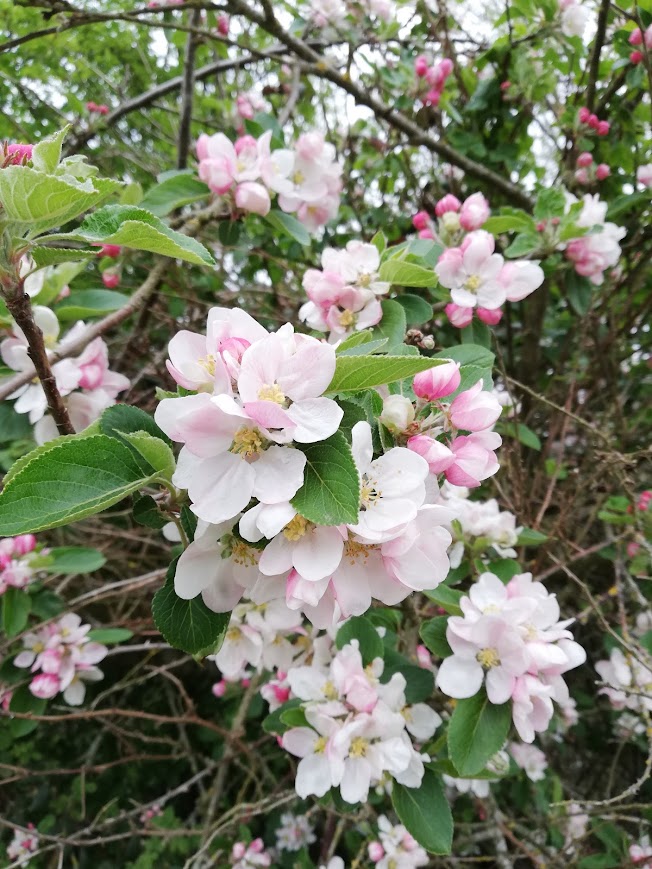
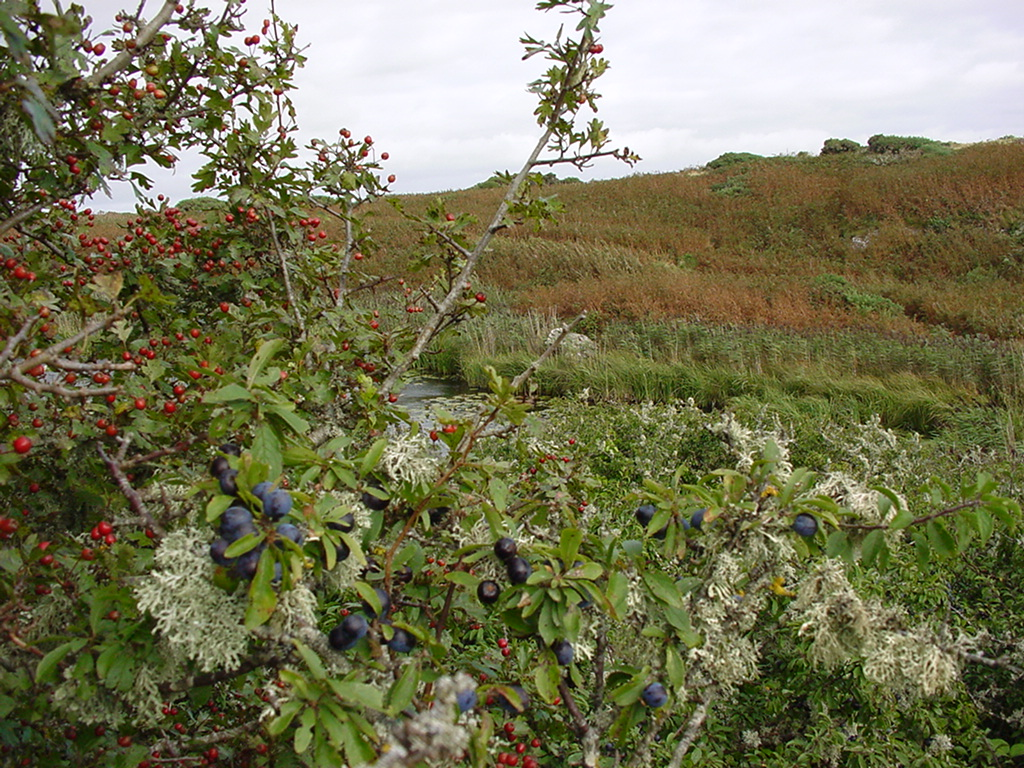
To mark the Autumn Equinox, I sat in silent contemplation of a small bunch of Hawthorn berries – haws. They were a trigger for seeing the huge cycle of Life which our lives and our species are part of. Nature prepares a fertile ground for the fruits to fall when they have what is necessary to nurture the new forms as they become. What have we been given to create and nurture the seeds of the future? What fruits and seeds do each of us have to plant in what ground? Children yes, but many other seeds also. We have all been given more to pass on than we realise. Skills, ideas, art forms, ways of living, of seeing, of making, healing, helping, guiding; what we have received, and have to give to others is endless. Some may fall on stony ground, that is the way of it, but some may fall in a rich fertile bed and it is also possible for us to assist in creating that bed.

Sinking into the dark of the year gives us a time to withdraw, to consider our acts, our thoughts, our efforts. To discover ways to prepare the ground of Being to receive the seeds of Knowledge, Wisdom and Understanding which lie buried within us, to help them develop and see where and how they may be planted to enhance this Life on earth.

Haws and sloes on Anglesey

And here are some other posts about Festivals

Morgan the Huntress

Posted on behalf of House Morgan.

Morgan hunts. Hunting, no matter the quarry, is a passion which requires skill. The hunter is driven to stalk, track, probe, uncover that which is issuing the summons, the call from a hidden place.

In the stalking, catching, but not necessarily killing, the prey is the passion that drives a true Hunter. Shooting may now involve a camera rather than a gun, hunting that special sharp ‘shot’. Skinning, stripping the surface, the outer layers from a ‘kill’ may involve words rather than a knife; may be more concerned with revealing a plot, a scam, a crime, a hidden identity, a hidden agenda.

The Hunter/Huntress, is found in many mythologies due to the vital place hunting held in tribal life. It remains active in many societies today, but is it still relevant? It depends on what you call hunting, and how you relate to the driving force behind it. Hunting was an ancestral necessity, an aspect of the instinct which ensured our survival and that of our tribe. The hunter held a highly responsible place in the life of a tribe. What skills they had! What faculties did they use? Seeing, dreaming, stillness, silence, their extraordinary sense perception on high alert, their whole body consciously aware of the presence surrounding them. Some hunted alone, some hunted in packs where every member knew each other’s skill and presence.

But hunters exist on other levels too. Those who seek knowledge, researchers in every sphere of life are hunters, what they hunt will, in one way or other, change their life and the life of others – revelation is always a risk and the hunter must act accordingly. Hunting is a visceral act, feeling the thread, the connection, to that which is hunted. The researcher or detective knowing they are on the brink of a discovery become remote, their passion palpable, their instinct alert, poised to recognise the revelation and pounce at the precise moment. Investigative journalists also, and barristers questioning a suspect or witness in court; they are all driven to hunt for truth. This is the root of the myths of the fantastic animal that leads the hunter into the Otherworld.

But is it possible to operate as a hunter in everyday life? To stay awake, alert, extend your senses to the limit. To develop extra-ordinary senses that receive information without immediately placing meaning onto it. To stay awake, to stalk the mystery, moving slowly, quietly, becoming still, remaining hidden, ‘touching the world lightly’. To use your senses to inform, your mind to question, your will to keep on track.

The hunting of living creatures requires study; study of their habitat, their habits, their food, their needs, their routines, all these are clues necessary to a successful hunt. If you were being hunted, how easy would it be to trap you? Are you aware of your habits, your routines? Times, places, travel, work, recreation, contacts, attitude, responses; is your life predictable, are you predictable? Is it possible to outwit a Hunter/ Stalker and lead them away, misdirect them?

Being alert, attentive, vigilant, reading the signs, the hunter patiently waits and watches, if something is hidden they will uncover it; unless they recognise and acknowledge the need to call off the hunt.
Gathering may complement hunting. Traditionally, they have been considered two separate activities but are they so different? What are the qualities they share? Use of all the senses. Attention to season, terrain, memory. How were new foods discovered? New plants for healing? How did they find out what part is active, leaf, flower, root, seed? Again, the honing of all the senses in the service of Attention is essential; error leads to sickness and death. This is the true meaning and purpose of sensitivity. Are you sensitive?

As the advent of agriculture and associated husbandry led to the development of civilisation the need to hunt for food dwindled. But is physical food our only requirement for growth and sustenance? Consider the food required to fulfil our other needs; food for the mind, the heart, the spirit. The hunt for your path, your partner, your profession or career, your passion. What feeds your passion, what gives your life meaning?

Archeologists hunt our past to enrich our future. Their discoveries of ancient ruins, ancient languages, the earliest writings, the earliest music, our measurement of time and depictions of early god forms have all been revealed by these passionate hunters. Without their findings most of our diverse cultural heritage would remain lost and our lives much the poorer. And those who hunt their ancestry, currently a very popular activity, how does it feel to recognise a name, date, place that fits? You’ve been hunting.

Hunters methods are subtle, invisible, how do they track the mysteries that lie beneath the surface? Some call it the Underworld as much of what we value begins as hidden treasure – gold, silver, jewel, histories, seeds, truths – all lie beneath a covering, a surface. Truth can be staring us in the face, but perhaps we prefer not to see it.

But the greatest hunter is Death. Death stalks you all your life and can take you at any moment, are you prepared? “In a world where death is the Hunter, my friend, there is no time for regrets or doubts. There is only time for decision.”*

How can you prepare? By hunting that which feeds the deeper parts of you and store its power for use when needed. The greatest power to draw the Hunter is Knowledge, Knowledge not information. Information is what intrigues the mind and forms signposts along the way.
Knowledge that transforms the being, nurtures the soul and frees the spirit.

* Carlos Castaneda Journey to Ixtlan

House Morgan

Lunar standstill at Callanish

I first encountered the idea of lunar standstills at the Callanish stone circle on the Isle of Lewis in the Outer Hebrides. The story is that every 18.6 years, the moon goes through a major standstill, where it rises only a few degrees, and appears to roll along the horizon. From the viewpoint of Callanish, the moon runs along hills which have the appearance of a woman lying on her back, the so-called Sleeping Beauty or Cailleach of the Moors. After a few hours the moon sets, and then momentarily it re-appears silhouetted in a valley on the horizon. If you stand outside the circle of Callanish, the moon passes among the stones. The last major standstill was in 2006, and so the next one is due in 2025, although the effects can be seen now!

Shown below is a picture I took of the stones at Callanish with the moon behind them when I visited in May 2019. The moon was quite high at the time (peaking at around 20° above the horizon). During a standstill the moon only rises to about 3°, and because it is close to the horizon, it appears much larger!

Shown below is a photo showing what the moon looks like at the standstill, with a full moon walking through the stones. (Photo from the late Margaret Curtis at https://www.geo.org/callan.htm.).

Shown below is a photo I took of the Sleeping Beauty hills from Callanish. I think the grey ones in the background are the woman, with her head to the right, laying against the ‘pillow’ of the closer hills. As you move around the island, you can still see the woman, although the outline changes a bit. From nearby Achmore stone circle, for example, the arrangement of hills makes her appear pregnant.  You might like to read Jill Smith’s article on walking the Sleeping Beauty Mountain: https://goddess-pages.co.uk/galive/issue-19-home/walking-the-sleeping-beauty-mountain/

Where else do we see the standstill?

The major lunar standstill can be seen everywhere. If you are much further north than Callanish, the moon sometimes doesn’t rise at all at the standstill. At lower latitudes the moon rises higher, but still at a minimum altitude. In London for example the moon rises to about 9°, less impressive but still worth watching. If you’re in the southern hemisphere, then you get the same effect, but at a different time of year.

When can we see the standstill?

We are talking about a long (18.6 year) cycle, and so we can see the effects of the standstill (at least to some extent) for a few years on either side of the main date. We can see an echo every month (well, every 27.21 days) when the moon is at the right place in its orbit. Of course it isn’t noticeable every month, because sometimes the moon is rising in daylight or is a very thin crescent. It’s more noticeable when the moon is full. For this sequence we get a good chance of seeing it this year on 21st/22nd June 2024, and next year on 11th/12th June 2025. Details are included at the end of this article. Of course you have to have clear weather to see it properly!

Why 18.6 years?

Understanding the interval of 18.6 years between major lunar standstills is tricky (and I’m still not 100% sure I understand it), so you can skip this bit if you like!

We have to look at the way the moon goes round the earth, and the earth goes round the sun.  The diagram below illustrates the orbits. The earth (green) goes around the sun, each orbit taking a year. The plane of the earth’s orbit, called the ecliptic, is shown in yellow. The moon (blue), goes round the earth, but its (blue) orbit is not in the same plane as the ecliptic – it is tilted, by about 5.1˚ So, during one orbit, as it goes around the earth, the moon rises above the ecliptic plane, and then falls below it. The two points where it crosses over the ecliptic are called the lunar nodes: the ascending node (AN in the diagram) and the descending node (DN). The moon takes 27.21 days to make a full orbit through the nodes (this is called a draconic month).

From https://en.wikipedia.org/wiki/Orbit_of_the_Moon

The orientation of the tilt in the moon’s orbit about the earth changes over a period of about 18.6 years. In the diagram as shown, the line joining the nodes is more or less perpendicular to the earth-sun line. But this line rotates so that, about 9 years later, the two nodes will line up with the sun-earth line. This is important for predicting eclipses, because an eclipse can only take place when the sun, moon and earth are aligned, which only happens if the moon is in the plane of the ecliptic (at one of the nodes).

But for major lunar standstills, we’re interested in the points where the line between the nodes is as shown in the diagram. This is because the moon in its orbit is reaching as far as it can above and below the ecliptic.

The diagram below illustrates what we see on earth. Each night the moon rises somewhere in the east, and sets at a corresponding point in the west. Every night the moonrise moves along the horizon between two limits in the north and south. The moon rises higher when the moonrise and set are in the north, and it rises less when the rise and set are in the south.

The north and south limits also move – on the 18.6 year cycle. At the major standstill, the moonrise swings in a single month from far north-east to south-east. For example in June 2025 at Callanish, the moonrise will swing between 26˚ in the northeast, to 155˚ in the southeast. Half-way through the 18.6 year cycle (at what is called the minor lunar standstill) the range of the moonrise across the month is smaller. For example in February 2016 at Callanish, the moonrise swings between 54˚ in the northeast, to 127˚ in the southeast.

Image from https://www.umass.edu/sunwheel/pages/moonteaching.html

The 2006 Standstill

The most recent standstill was in 2006, and there is a blog by Gerald Ponting recording the event at Callanish, covering 11th-12th June: http://home.clara.net/gponting/page44.html

According to https://www.timeanddate.com/moon/@2653988?month=6&year=2006
The moon rose at 23:38 on 11th June, at 154˚ (about 25˚ East of South)
The moon set at 03:41 on 12th June at 205˚ (about 25˚ West of South)
The moon peaked at 01:40 on 12th June at an altitude of 2.8˚.

According to Gerald’s blog, the moon appeared above the sleeping figure at 12:11, and was clear of the horizon at 12:20. He didn’t see the ‘regleam’ where the moon re-appears momentarily before finally setting.

Drawing the 154˚ and 205˚ arcs on the map points roughly to the sleeping beauty (moonrise) and Glen Langadale (regleam). Both of these are on the southern part of Lewis. According to Margaret Curtis, Glen Langadale is hidden by hills to the south of Callanish, but the recleam effect is gained within the circle as the setting moon appears from behind the rocky hillock next to the circle (Cnoc an Tursa).

The 2024 and 2025 Standstill

The following moon data for Callanish illustrates that from June 2024 to June 2025, the effect repeats more of less the same, on a monthly basis. It is more easily observed at the full moons which occur near the Summer solstice.

Full moon near summer solstice 2024: 21st/22nd June
According to https://www.timeanddate.com/moon/@2653988?month=6&year=2024
The moon rises and sets at 23:26 (155˚) to 03:27 (205˚), meridian passing at 01:27 (2.7˚ altitude).

Spring equinox 2025: 22 March 2025
According to https://www.timeanddate.com/moon/@2653988?month=3&year=2025
The moon rises and sets at 04:30 (156˚) to 08:18 (204˚), meridian passing at 06:24 (2.4˚ altitude).

Full moon near summer solstice 2025: 11th/12th June
According to https://www.timeanddate.com/moon/@2653988?month=6&year=2025   
The moon rises and sets at 00:02 (155˚) to 04:02 (205˚), meridian passing at 02:02 (2.7˚ altitude).

New Information!

A friend recently told me about an easier way of thinking about the timing of the major lunar standstills. They come about when the moon’s north node (the dragon’s head) enters the sign of Aries. This makes sense (I think), because the line between the moon’s nodes represents the axis of tilting of the moon’s orbit, and the line between 0˚ Aries and 0˚ Libra is the axis of tilting of the sun’s orbit, so when they align is when their tilts can add and subtract the most. This also has the benefit of being able to define a precise time for the standstill (even though it has a monthly effect for a couple of years). Using the moon’s true node position, the Ephemeris gives a date of 12th January 2025 for the next major lunar standstill. A similar lookup gives the date of the previous one as 22nd June 2006, and before that 3rd December 1987, 20th April 1969 and 27th July 1950.

New, New Information!

I’m told by those who know that the upcoming date and time for the dragon’s head passing through 0˚ Aries (for London) is 5:41pm on Saturday 11th January 2025.

Additional Reading material:

If you want more detail have a look at https://en.wikipedia.org/wiki/Lunar_standstill.

Archaeoastronomy for Archaeologists http://www.bajr.org/BAJRGuides/43_Archaeo-Astronomy/43_ArchaeAstronomy.pdf