Thornborough Henges

The Thornborough Henges in North Yorkshire are a set of three huge circular henges, each around 250m in diameter, spaced out by about 500m on an approximate northwest-southeast alignment. They date from between 3500 and 2500 BC.
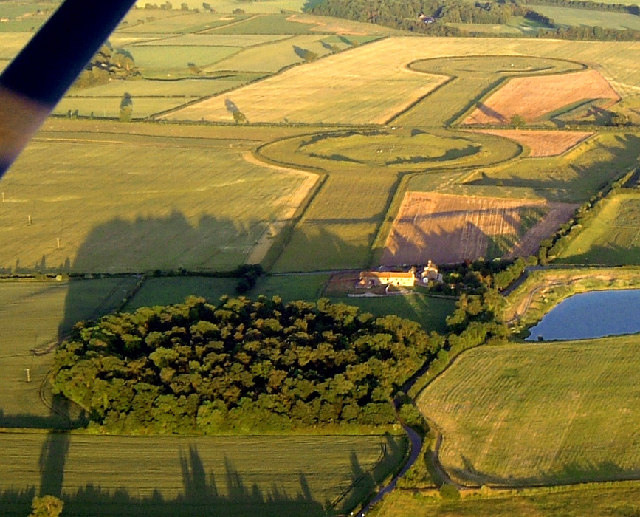

Looking south (the nearest henge is wooded!). Image via wikimedia.

What stands out to me about the henges?

They’re very big! They were built with a bank maybe 4 metres tall around them, and inside the bank a flat space and then a ditch around the flat Central area. Apparently they had 700 people there one recent Beltane!

With the banks at full height you’d only see the sky from within, no hills on the horizon. The banks were apparently faced with white gypsum. I wonder if they posted people or symbols or lights on the bank marking the stars rising and other astronomical events?
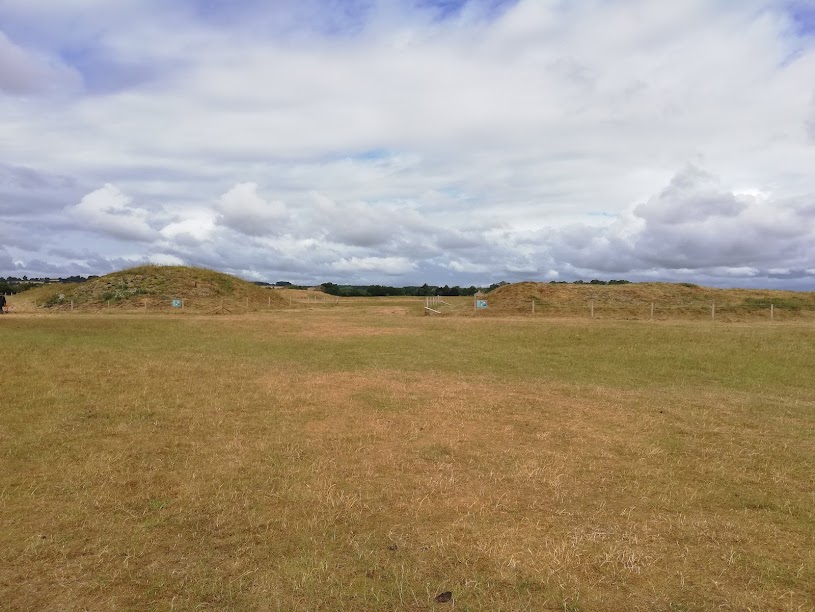

At the entrance to the central henge, with the wooded henge in the background.
From my visit in Summer 2025.

Orion


The three henges are not quite in a straight line, but seem to have the same alignment as the three stars of Orion’s belt. Also, before the henges were built there was a straight cursus (or ditch) dug at right angles to the line of henges, and passing through the central ring. It was roughly pointed towards where Orion would set in the West at the start of autumn. The cursus would have been cut through the trees, so maybe it was a sight line?


By Till Credner via Wikimedia

Is this apparent alignment with Orion a coincidence? Well other sites might have similar alignments. According to Sigurd Towrie, there are sites on Orkney that might have a similar mirroring of the belt-stars. There’s also a (controversial) theory that the pyramids in Egypt align with the belt.

What might Orion have meant to stone age people? Personally it’s my favorite winter constellation – easy to spot even in London, and somehow a comforting presence on clear winter nights.  Perhaps to them it was a marker of the season, or perhaps a reminder of something more. Sigurd Towrie’s article also discusses Stonehenge, and the theory that it may be associated with a mid-winter healing deity. Did Orion represent this ancient prehistoric god? A deity who presided over the darkest time of the year?

I recommend a visit to Thornborough Henges – especially on a clear winter’s night!

Impression of Thornborough Henges ca 2,500BC
by Peter Dunn.

Spring Equinox at Arbor Low

This year I spent the spring equinox with friends in Derbyshire, visiting two of the stone circles from the Bull Tor triangle. The journey between these circles and the exercises carried out at each of them are the subject of the book The Dancing Circles (see an earlier article here). This time we visited Arbor Low and Eyam Moor Stone Circle, and I have a little bit to say about our time at Arbor Low.

Arbor Low Stone Circle by Graham Hogg, via Wikimedia Commons

Thursday was unusually warm and sunny, but approaching Arbor Low in the morning there was a white haze blanketing the hills, like a cocoon under which spring was being prepared. The trees were beginning to bud, and crocuses were in flower in the circle itself. Sky larks were trilling in the air above us.

The exercise for Arbor Low aims to still the mind, and consists of visualising the sun’s progress through the sky from sunrise to sunset, taking about ten minutes for the entire imaginary arc. The equinox is a good day to do this exercise, because the sun rises due east, sets due west, and rises to a point due south of the zenith at noon. This arch of course extends under the earth, where the sun travels at night, making a circle with a spindle through the centre which points towards the north star.

The exercise did seem to work, and perhaps there is something about the nature of the sun’s motion that helps. We know it moves across the sky, but it looks stationary. The exercise brings an awareness of this contrast into the mind, so that we can experience both change and stillness, and perhaps be aware of the bigger world we live in.

Happy Equinox!

Festivals

A friend suggested that we include a new category of posts – about the festivals. It would be nice if people were to add their comments and experiences to the posts as well. Here’s the starter she provided:

Autumn Equinox

To mark the Autumn Equinox, I sat in silent contemplation of a small bunch of Hawthorn berries – haws. They were a trigger for seeing the huge cycle of Life which our lives and our species are part of. Nature prepares a fertile ground for the fruits to fall when they have what is necessary to nurture the new forms as they become. What have we been given to create and nurture the seeds of the future? What fruits and seeds do each of us have to plant in what ground? Children yes, but many other seeds also. We have all been given more to pass on than we realise. Skills, ideas, art forms, ways of living, of seeing, of making, healing, helping, guiding; what we have received, and have to give to others is endless. Some may fall on stony ground, that is the way of it, but some may fall in a rich fertile bed and it is also possible for us to assist in creating that bed.

Sinking into the dark of the year gives us a time to withdraw, to consider our acts, our thoughts, our efforts. To discover ways to prepare the ground of Being to receive the seeds of Knowledge, Wisdom and Understanding which lie buried within us, to help them develop and see where and how they may be planted to enhance this Life on earth.

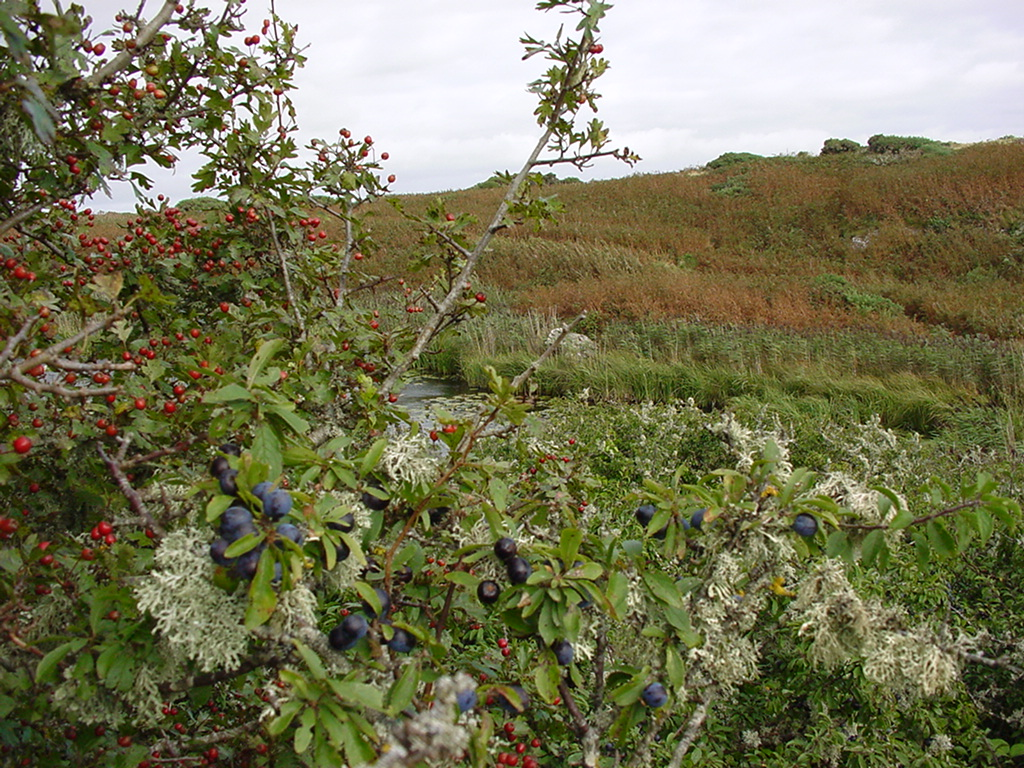
Haws and sloes on Anglesey

And here are some other posts about Festivals

Winter Solstice

The solstice marks mid-winter, the time when the sun’s path is lowest in the sky, nights are at their longest, and the days shortest. The sun has reached its weakest point, and light and heat are in short supply. It is a time to acknowledge the dark and the cold, but to carry the light and warmth through to the new year.

In the dark a new spark of light grows. This is a moment when change can take place.

The lead-up to the solstice has been unusually cold this year in Britain, and my attention has been focussed onto the temperature – by having my heating break down. How precious warmth and light is, but how easily we take it for granted. The one night of mid-winter is a good time to remember this, and to hold vigil for the light.

It’s not surprising that traditions for marking this time involve light or fire, for example lighting a candle in the dark, or burning a Yule log on the fire. For me, it’s fire embers glowing in the dark, or a candle lit in the room. I like to sit in silence with only the quiet sound of the fire. Of course, watching the sun set and then rise again is also an important part of marking the occasion. I try to keep an awareness of the sun travelling underneath the world from its setting to its rising.

Winter Solstice Sunset

Our ancestors clearly thought the winter solstice was important, and some particularly marked the mid-winter sunset. The Maeshowe chambered cairn on Orkney for example was designed so that the rays of the setting mid-winter sun would shine down the entrance passage to the centre of the tomb. The main alignment at Stonehenge is the mid-summer sunrise, and the mid-winter sunset.

In Carmina Geadelica, Alexander Carmicheal describes a ceremonial way of covering a peat fire for the night:

“The ceremony of smooring the fire is artistic and symbolic, and is performed with loving care. The embers are evenly spread on the hearth–which is generally in the middle of the floor–and formed into a circle. This circle is then divided into three equal sections, a small boss being left in the middle. A peat is laid between each section, each peat touching the boss, which forms a common centre. The first peat is laid down in name of the God of Life, the second in name of the God of Peace, the third in name of the God of Grace. The circle is then covered over with ashes sufficient to subdue but not to extinguish the fire, in name of the Three of Light. The heap slightly raised in the centre is called ‘Tula nan Tri,’ the Hearth of the Three.”

The following protective prayer might be said whilst covering the fire:

THE sacred Three
To save,
To shield,
To surround
The hearth,
The house,
The household,
This eve,
This night,
Oh! this eve,
This night,
And every night,
Each single night.
                Amen.

After the long night, the sun rises again, now getting stronger, with the dark giving way to the light. It is a time for celebration and new beginnings. Some ancient places mark the sunrise instead of the sunset at mid-winter. For example Newgrange in Ireland has a specially designed roof-box which allows light from the mid-winter sunrise to shine into the central chamber.

Winter Solstice Sunrise

Blessings for the solstice!