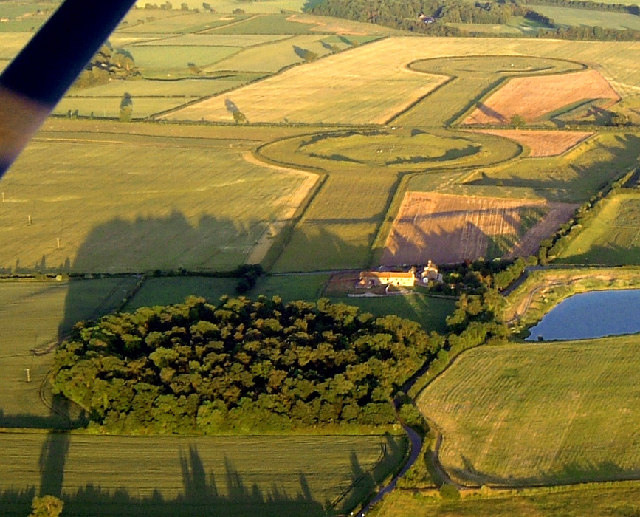
The Thornborough Henges in North Yorkshire are a set of three huge circular henges, each around 250m in diameter, spaced out by about 500m on an approximate northwest-southeast alignment. They date from between 3500 and 2500 BC.
Looking south (the nearest henge is wooded!). Image via wikimedia.
What stands out to me about the henges?
They’re very big! They were built with a bank maybe 4 metres tall around them, and inside the bank a flat space and then a ditch around the flat Central area. Apparently they had 700 people there one recent Beltane!
With the banks at full height you’d only see the sky from within, no hills on the horizon. The banks were apparently faced with white gypsum. I wonder if they posted people or symbols or lights on the bank marking the stars rising and other astronomical events?
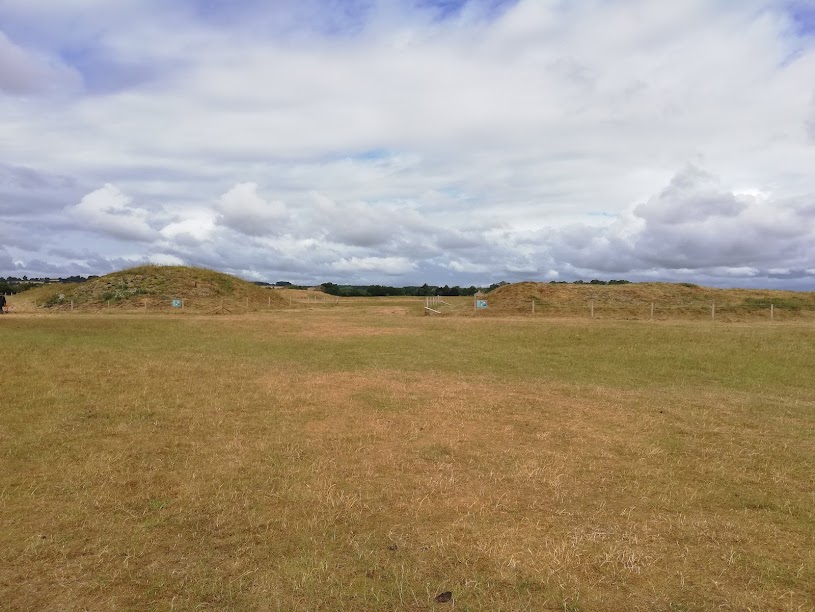
At the entrance to the central henge, with the wooded henge in the background. From my visit in Summer 2025.
Orion
The three henges are not quite in a straight line, but seem to have the same alignment as the three stars of Orion’s belt. Also, before the henges were built there was a straight cursus (or ditch) dug at right angles to the line of henges, and passing through the central ring. It was roughly pointed towards where Orion would set in the West at the start of autumn. The cursus would have been cut through the trees, so maybe it was a sight line?
By Till Credner via Wikimedia
Is this apparent alignment with Orion a coincidence? Well other sites might have similar alignments. According to Sigurd Towrie, there are sites on Orkney that might have a similar mirroring of the belt-stars. There’s also a (controversial) theory that the pyramids in Egypt align with the belt.
What might Orion have meant to stone age people? Personally it’s my favorite winter constellation – easy to spot even in London, and somehow a comforting presence on clear winter nights. Perhaps to them it was a marker of the season, or perhaps a reminder of something more. Sigurd Towrie’s article also discusses Stonehenge, and the theory that it may be associated with a mid-winter healing deity. Did Orion represent this ancient prehistoric god? A deity who presided over the darkest time of the year?
I recommend a visit to Thornborough Henges – especially on a clear winter’s night!
Impression of Thornborough Henges ca 2,500BC by Peter Dunn.
In legend, Radnor forest is the place of the last dragon in Wales, and it sleeps. Roundabout the forest are five St Michael Churches which supposedly control or contain the dragon. All are built on ancient mounds and surrounded by yew trees. They are (anticlockwise):
Cascob (North-East)- It’s near where John Dee’s family came from (see below), and a magic spell was found in the churchyard and now hangs in the church. There’s also a special fluted yew tree there.
This large timber enclosure was just south of Evenjobb. Nothing to see now I don’t think, but the road pattern follows the outline of the (huge) enclosure. https://www.megalithic.co.uk/article.php?sid=19715
There is a barrow, 19m in diameter and 1.2m high, set upon Whimble, a conical hill, and it has a more recent cairn, 11m in diameter and 0.6m high, superimposed upon it. https://www.megalithic.co.uk/article.php?sid=34221
Now… There’s a hill which dominates the view from the East. Here’s a picture taken from the road through Evenjobb, showing a rounded hill poking up in Radnor Forest. It seems significant that is overlooks the whole of the basin. Is it Whimble Hill? What do you think? Whatever it is it make me think the dragon is somewhere there! I want to explore there some more!
This is something I wrote 12 years ago, about a magical walk on Llangoed common in Wales. I’ve been thinking about it a lot recently, and it’s the right time of year for it.
I first encountered the idea of lunar standstills at the Callanish stone circle on the Isle of Lewis in the Outer Hebrides. The story is that every 18.6 years, the moon goes through a major standstill, where it rises only a few degrees, and appears to roll along the horizon. From the viewpoint of Callanish, the moon runs along hills which have the appearance of a woman lying on her back, the so-called Sleeping Beauty or Cailleach of the Moors. After a few hours the moon sets, and then momentarily it re-appears silhouetted in a valley on the horizon. If you stand outside the circle of Callanish, the moon passes among the stones. The last major standstill was in 2006, and so the next one is due in 2025, although the effects can be seen now!
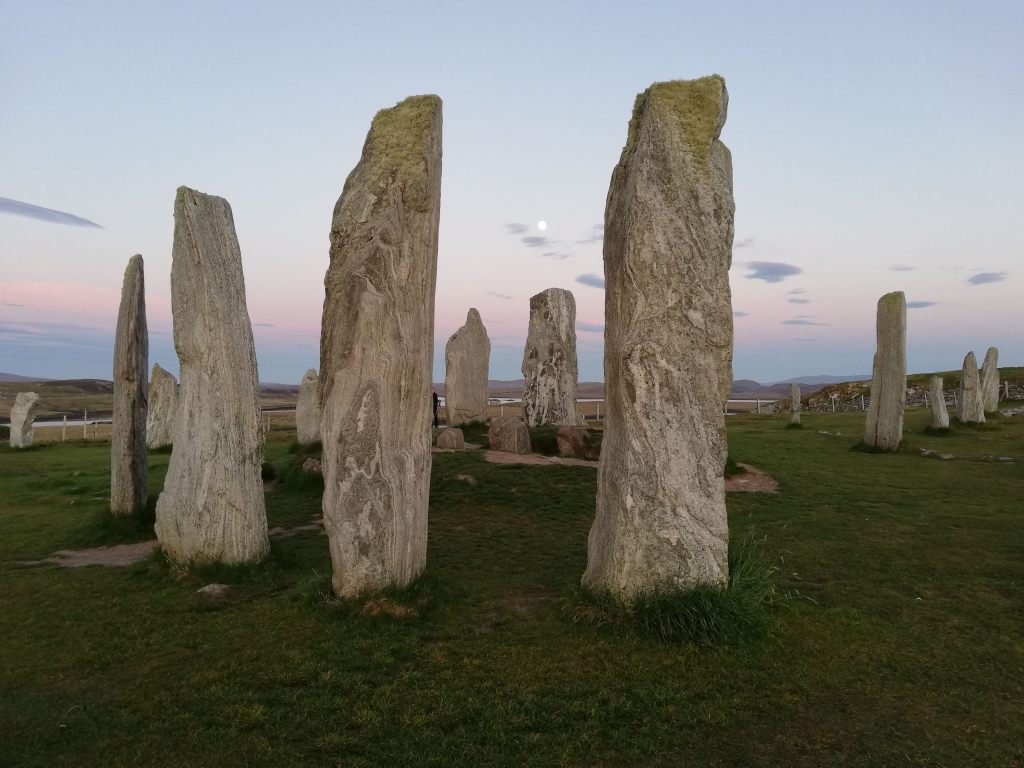
Shown below is a picture I took of the stones at Callanish with the moon behind them when I visited in May 2019. The moon was quite high at the time (peaking at around 20° above the horizon). During a standstill the moon only rises to about 3°, and because it is close to the horizon, it appears much larger!
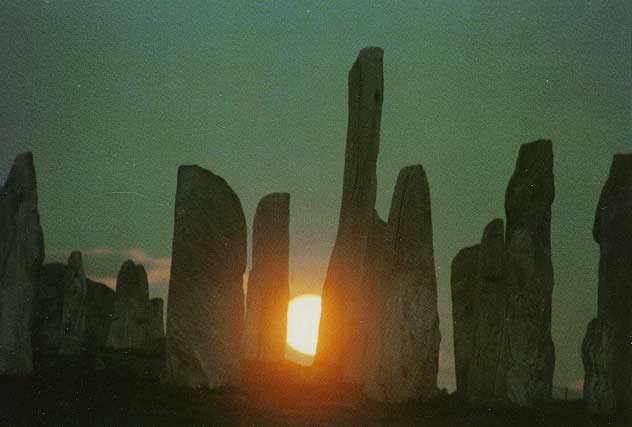
Shown below is a photo showing what the moon looks like at the standstill, with a full moon walking through the stones. (Photo from the late Margaret Curtis at https://www.geo.org/callan.htm.).
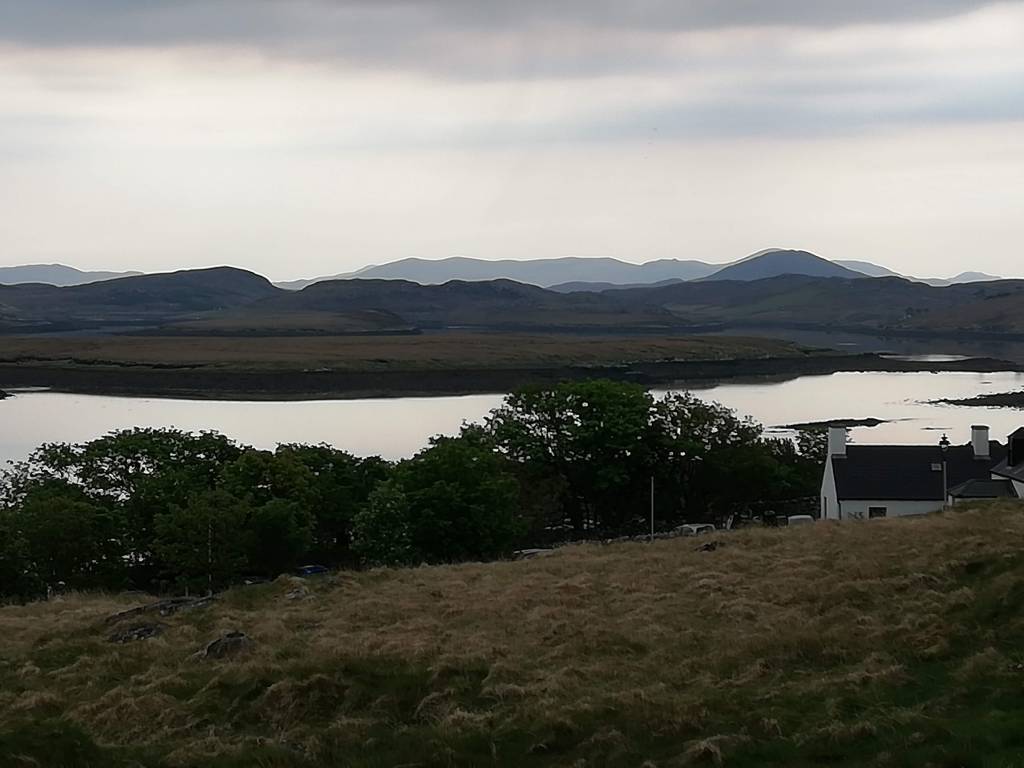
Shown below is a photo I took of the Sleeping Beauty hills from Callanish. I think the grey ones in the background are the woman, with her head to the right, laying against the ‘pillow’ of the closer hills. As you move around the island, you can still see the woman, although the outline changes a bit. From nearby Achmore stone circle, for example, the arrangement of hills makes her appear pregnant. You might like to read Jill Smith’s article on walking the Sleeping Beauty Mountain: https://goddess-pages.co.uk/galive/issue-19-home/walking-the-sleeping-beauty-mountain/
Where else do we see the standstill?
The major lunar standstill can be seen everywhere. If you are much further north than Callanish, the moon sometimes doesn’t rise at all at the standstill. At lower latitudes the moon rises higher, but still at a minimum altitude. In London for example the moon rises to about 9°, less impressive but still worth watching. If you’re in the southern hemisphere, then you get the same effect, but at a different time of year.
When can we see the standstill?
We are talking about a long (18.6 year) cycle, and so we can see the effects of the standstill (at least to some extent) for a few years on either side of the main date. We can see an echo every month (well, every 27.21 days) when the moon is at the right place in its orbit. Of course it isn’t noticeable every month, because sometimes the moon is rising in daylight or is a very thin crescent. It’s more noticeable when the moon is full. For this sequence we get a good chance of seeing it this year on 21st/22nd June 2024, and next year on 11th/12th June 2025. Details are included at the end of this article. Of course you have to have clear weather to see it properly!
Why 18.6 years?
Understanding the interval of 18.6 years between major lunar standstills is tricky (and I’m still not 100% sure I understand it), so you can skip this bit if you like!
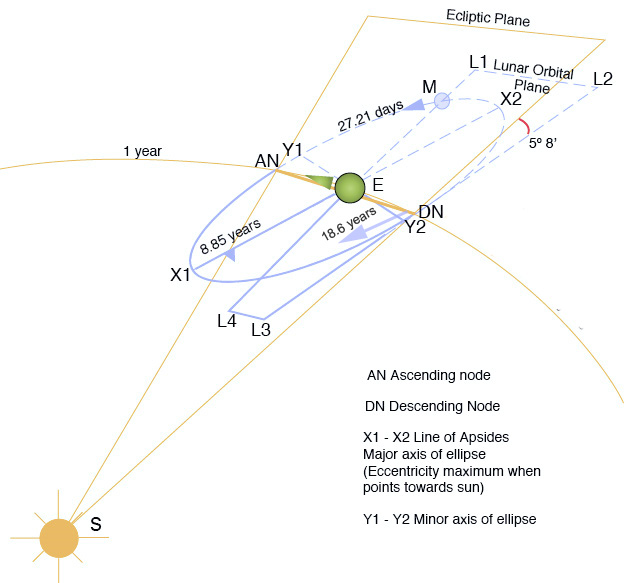
We have to look at the way the moon goes round the earth, and the earth goes round the sun. The diagram below illustrates the orbits. The earth (green) goes around the sun, each orbit taking a year. The plane of the earth’s orbit, called the ecliptic, is shown in yellow. The moon (blue), goes round the earth, but its (blue) orbit is not in the same plane as the ecliptic – it is tilted, by about 5.1˚ So, during one orbit, as it goes around the earth, the moon rises above the ecliptic plane, and then falls below it. The two points where it crosses over the ecliptic are called the lunar nodes: the ascending node (AN in the diagram) and the descending node (DN). The moon takes 27.21 days to make a full orbit through the nodes (this is called a draconic month).
The orientation of the tilt in the moon’s orbit about the earth changes over a period of about 18.6 years. In the diagram as shown, the line joining the nodes is more or less perpendicular to the earth-sun line. But this line rotates so that, about 9 years later, the two nodes will line up with the sun-earth line. This is important for predicting eclipses, because an eclipse can only take place when the sun, moon and earth are aligned, which only happens if the moon is in the plane of the ecliptic (at one of the nodes).
But for major lunar standstills, we’re interested in the points where the line between the nodes is as shown in the diagram. This is because the moon in its orbit is reaching as far as it can above and below the ecliptic.
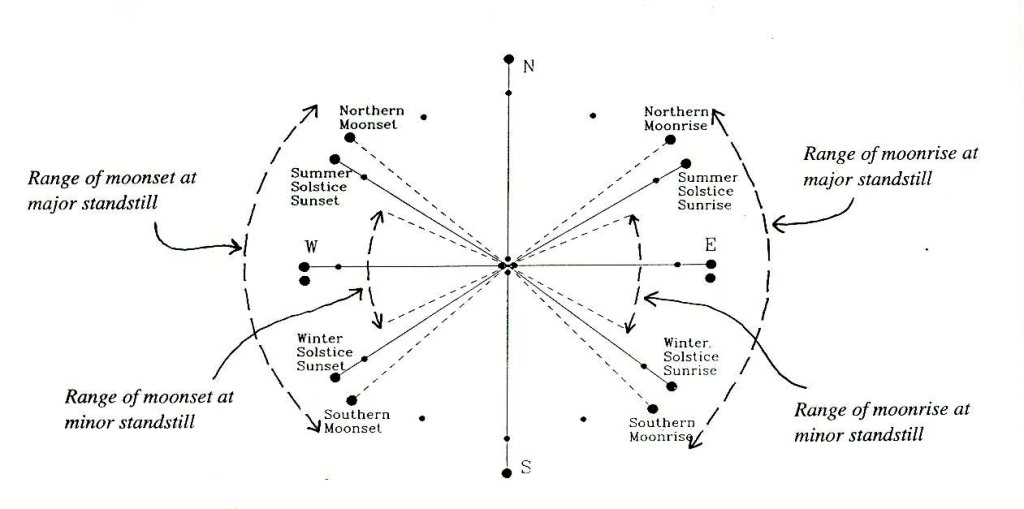
The diagram below illustrates what we see on earth. Each night the moon rises somewhere in the east, and sets at a corresponding point in the west. Every night the moonrise moves along the horizon between two limits in the north and south. The moon rises higher when the moonrise and set are in the north, and it rises less when the rise and set are in the south.
The north and south limits also move – on the 18.6 year cycle. At the major standstill, the moonrise swings in a single month from far north-east to south-east. For example in June 2025 at Callanish, the moonrise will swing between 26˚ in the northeast, to 155˚ in the southeast. Half-way through the 18.6 year cycle (at what is called the minor lunar standstill) the range of the moonrise across the month is smaller. For example in February 2016 at Callanish, the moonrise swings between 54˚ in the northeast, to 127˚ in the southeast.
The most recent standstill was in 2006, and there is a blog by Gerald Ponting recording the event at Callanish, covering 11th-12th June: http://home.clara.net/gponting/page44.html
According to https://www.timeanddate.com/moon/@2653988?month=6&year=2006 The moon rose at 23:38 on 11th June, at 154˚ (about 25˚ East of South) The moon set at 03:41 on 12th June at 205˚ (about 25˚ West of South) The moon peaked at 01:40 on 12th June at an altitude of 2.8˚.
According to Gerald’s blog, the moon appeared above the sleeping figure at 12:11, and was clear of the horizon at 12:20. He didn’t see the ‘regleam’ where the moon re-appears momentarily before finally setting.
Drawing the 154˚ and 205˚ arcs on the map points roughly to the sleeping beauty (moonrise) and Glen Langadale (regleam). Both of these are on the southern part of Lewis. According to Margaret Curtis, Glen Langadale is hidden by hills to the south of Callanish, but the recleam effect is gained within the circle as the setting moon appears from behind the rocky hillock next to the circle (Cnoc an Tursa).
The 2024 and 2025 Standstill
The following moon data for Callanish illustrates that from June 2024 to June 2025, the effect repeats more of less the same, on a monthly basis. It is more easily observed at the full moons which occur near the Summer solstice.
A friend recently told me about an easier way of thinking about the timing of the major lunar standstills. They come about when the moon’s north node (the dragon’s head) enters the sign of Aries. This makes sense (I think), because the line between the moon’s nodes represents the axis of tilting of the moon’s orbit, and the line between 0˚ Aries and 0˚ Libra is the axis of tilting of the sun’s orbit, so when they align is when their tilts can add and subtract the most. This also has the benefit of being able to define a precise time for the standstill (even though it has a monthly effect for a couple of years). Using the moon’s true node position, the Ephemeris gives a date of 12th January 2025 for the next major lunar standstill. A similar lookup gives the date of the previous one as 22nd June 2006, and before that 3rd December 1987, 20th April 1969 and 27th July 1950.
New, New Information!
I’m told by those who know that the upcoming date and time for the dragon’s head passing through 0˚ Aries (for London) is 5:41pm on Saturday 11th January 2025.
The solstice marks mid-winter, the time when the sun’s path is lowest in the sky, nights are at their longest, and the days shortest. The sun has reached its weakest point, and light and heat are in short supply. It is a time to acknowledge the dark and the cold, but to carry the light and warmth through to the new year.
In the dark a new spark of light grows. This is a moment when change can take place.
The lead-up to the solstice has been unusually cold this year in Britain, and my attention has been focussed onto the temperature – by having my heating break down. How precious warmth and light is, but how easily we take it for granted. The one night of mid-winter is a good time to remember this, and to hold vigil for the light.
It’s not surprising that traditions for marking this time involve light or fire, for example lighting a candle in the dark, or burning a Yule log on the fire. For me, it’s fire embers glowing in the dark, or a candle lit in the room. I like to sit in silence with only the quiet sound of the fire. Of course, watching the sun set and then rise again is also an important part of marking the occasion. I try to keep an awareness of the sun travelling underneath the world from its setting to its rising.
Winter Solstice Sunset
Our ancestors clearly thought the winter solstice was important, and some particularly marked the mid-winter sunset. The Maeshowe chambered cairn on Orkney for example was designed so that the rays of the setting mid-winter sun would shine down the entrance passage to the centre of the tomb. The main alignment at Stonehenge is the mid-summer sunrise, and the mid-winter sunset.
In Carmina Geadelica, Alexander Carmicheal describes a ceremonial way of covering a peat fire for the night:
“The ceremony of smooring the fire is artistic and symbolic, and is performed with loving care. The embers are evenly spread on the hearth–which is generally in the middle of the floor–and formed into a circle. This circle is then divided into three equal sections, a small boss being left in the middle. A peat is laid between each section, each peat touching the boss, which forms a common centre. The first peat is laid down in name of the God of Life, the second in name of the God of Peace, the third in name of the God of Grace. The circle is then covered over with ashes sufficient to subdue but not to extinguish the fire, in name of the Three of Light. The heap slightly raised in the centre is called ‘Tula nan Tri,’ the Hearth of the Three.”
The following protective prayer might be said whilst covering the fire:
THE sacred Three To save, To shield, To surround The hearth, The house, The household, This eve, This night, Oh! this eve, This night, And every night, Each single night. Amen.
After the long night, the sun rises again, now getting stronger, with the dark giving way to the light. It is a time for celebration and new beginnings. Some ancient places mark the sunrise instead of the sunset at mid-winter. For example Newgrange in Ireland has a specially designed roof-box which allows light from the mid-winter sunrise to shine into the central chamber.
There’s a part of us that likes patterns, and this can be played out in the landscape through alignments marked by ley lines or more complex arrangements like the Glastonbury zodiac. Significant places are linked together in a pattern, which amplifies their significance.
In the Peak District of Derbyshire, there is a triangle formed by three ancient sites: in the northwest, the Neolithic henge circle called The Bull Ring, in the northeast, the Eyam Moor stone circle called Wet Withens, and in the south the Arbor Low stone circle.
The triangle is not quite equal-sided. The distance between The Bull Ring and Wet Withens is about nine miles, compared to more than ten miles for the other two sides.
This triangle is a central theme in a recently published book called The Dancing Circles, by Andy Leaver Davies. I really enjoyed the book, which describes a tradition of journeying between the circles, and performing particular exercises at each of them. So here’s a bit about the circles and how they are described in the book.
The Bull Ring
The Bull ring, photo credit Dave Dunford, via Wikimedia
The Bull Ring is located on the edge of the village of Dove Holes, by the Cricket Club and Football field. It may have been a stone circle once, but now all that is left is a round circular earthwork with a mound in the middle. In the book, The Bull Ring is used as a place to bring the body into balance, using a simple circle dance.
Arbor Low
Arbor Low, photo credit Wikimedia
The 50+ stones which make up Arbor Low are all on their sides now, on a raised mound surrounded by a ditch and earthen bank. It’s located on high moorland, with long sight-lines to the horizon. In the book, Arbor Low is a place to learn how to open up and apply the mind.
Wet Withens
Wet Withens Chair Stone
For me, Wet Withens is the most elusive of the three circles – it took me three trips before I found it! Located on a gentle slope overlooking the River Derwent, the stones are mostly hidden in the heather, but there are a few large ones. The photo shows the largest stone, called the ‘Chair Stone’ (because of the ledge cut out of its face). Notice the similarity in shape of the top of the stone with the outline of Higger Tor on the horizon behind it. In the book, Wet Withens is linked to the development of feelings.
Bull Tor
Roughly at the centre of the triangle is a hilltop by the river Wye called Bull Tor, and in The Dancing Circles, this is the central place of the triangle, where the journey leads after building strength in the body, opening the mind, and developing the feelings. In the book, Andy’s teacher Tom talks about the people who started the journey and built the stone circles:
“For them, life was hard, dealing with pain, death and suffering. They had to look to their bodies to stop them getting ill. They had to learn about time and how to use it, because life was short. They had to learn to see through pain and suffering to the meaning behind it all. So they learned to join themselves to the land, to what came before and to what was to come. They learned to make themselves part of something, to see their short lives as a part of something bigger so that no matter how short, each life was part of the big plan. And they had to pass this down to the next generations so that each knew of their part in that bigger world. Their feelings of anger, hate, and love meant nothing by themselves. They just come and go like life comes and goes. If it’s not joined to something bigger, it means nothing at all. But if those feelings can be joined to something bigger, it can make them grow so someone can have feelings bigger than themselves. When that happens, all the pain and suffering can be put up against the bigger feelings and can have a meaning. The meaning in everything becomes clearer. There is still and always will be pain, but like life, it will come and go. The world can be faced.”
The Dancing Circles, p.148
Notes and Links:
The Dancing Circles: An extraordinary journey to a different way of living, Andy Leaver Davies, ISBN Dancing Circles Publishing (6 April 2021), 978-1838487515. Available on Amazon:
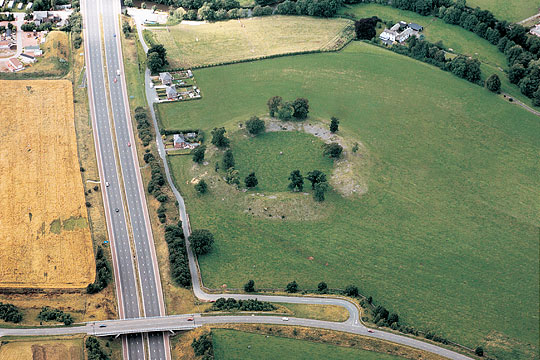
It survives as a single standing stone within a circular depression, around which is an impressive bank made of river pebbles culled from the nearby river. When you see the scale of the embankment, you realise just how much effort has gone into dragging that tonnage of river pebbles to the site. The site dates to the end of the Neolithic period or the beginning of the Bronze Age, which makes it about 4,500 years old.
Aerial view via English Heritage
No one knows exactly what this site was for. We can only look and imagine. But from historical records we know there were more standing stones here, and that the site was built near a spring and the confluence of the rivers Eamont and Lowther.
Map of 1769
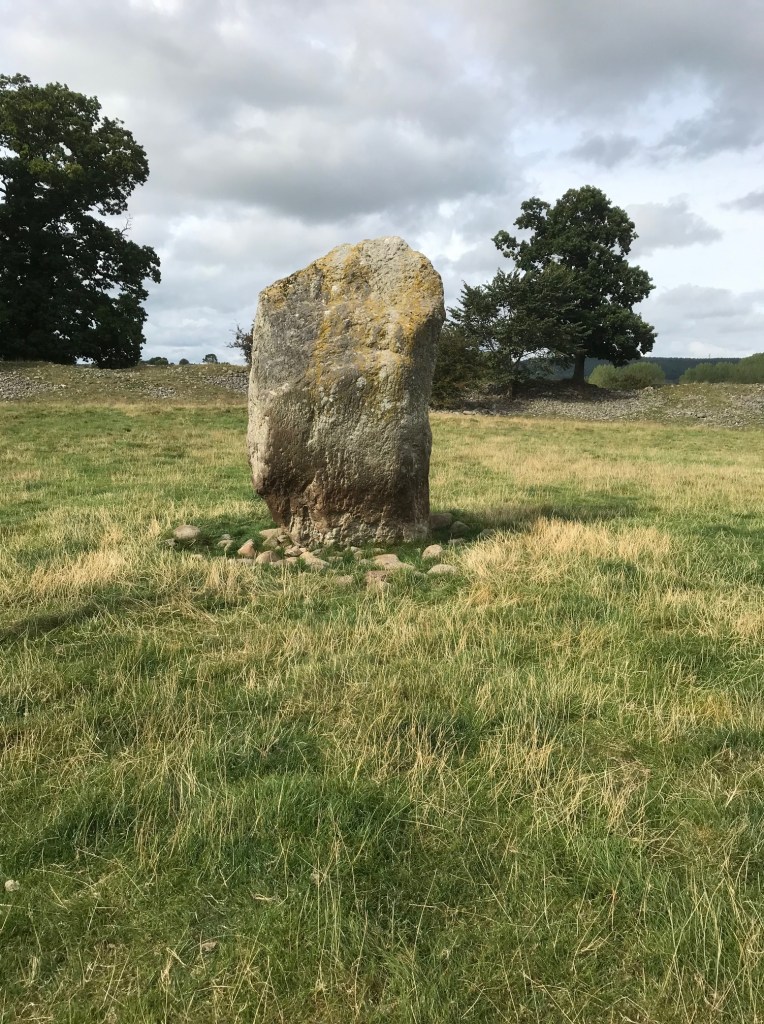
The single remaining stone is like a spindle at the centre – and the large depression forms a navel in the landscape, which curves in towards the site on all sides. The stone is taller than a man, and is exactly at the centre of the circular boundary.
It is single, embedded in the earth, yet pointing up to the sky.
The stars have turned around this axis over millennia.
It occurs to me that this is like the thoughts that are always circling around us, ready to take root.
The thoughts don’t belong to us, though sometimes we mistake them for ours. But we can let them pass, just the way this standing stone lets the turning of the stars pass. Lifespan after lifespan, it has been a witness to the ever-changing sky.
One of the attractions of this standing stone is its aloneness, its stillness and its silence.
Valley of the Ancients was a name I first came across on a South Wales Druid website. Described as the most holy pagan site in Wales, it has a stone circle complex and many other special places. It took a bit of exploring to find it, but it was worthwhile, and I have been back there a number of times over the years.
The valley is the upper reach of the River Tawe, which flows down to the sea at Abertawe (Swansea).
River Tawe in the Valley of the Ancients (some megaliths in the distance).
A small road runs through the valley from the A4067 in the Brecon Beacons just north of Glyntawe. On the approach from the south, you can see the Sleeping giant of Cribarth, a recumbent giant figure which guards the southern entrance to the valley.
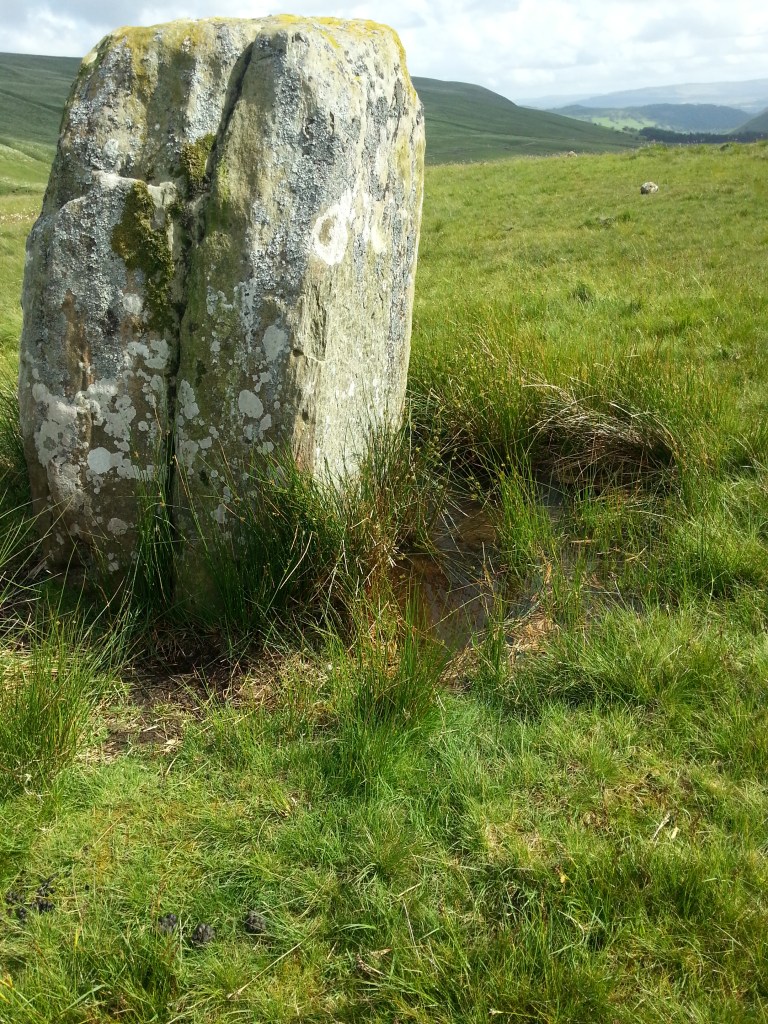
There is a megalithic complex in the valley called Cerrig Duon (the black stones), with a stone circle, some stone rows, and some large single stones, including this one, called Maen Mawr (Big Stone). To get to the stones you need to cross the river, which is always a challenge, and I suspect dangerous after rain!
Maen Mawr
The valley runs north to Glasfynydd Forest, and to the West lay the two ‘lakes of the peak’: Lyn y Fan Fawr and Lyn y Fan Fach, respectively the source of the Tawe, and source of the legend of the Lady of the Lake.
I’m sure I’ll be back again to explore more of this special place.