
The Voyage of Bran mac Feabhail

The Voyage of Bran is an old Irish story in the tradition of otherworldy sea-voyages [1]. It contains clues and hints to a different way of seeing the world. Bran, a king in Ireland, is called to the otherworld by a ‘women from unknown lands’ who appears from nowhere in the middle of a feast and sings to Bran of a magical land across the western ocean. She tells him to ‘begin a voyage across the clear sea’ to reach the Land of Women. Bran sets off, and on his way he meets the Irish sea god Manannán, who sings about a strange vision of the sea around him, and about the land across the sea. Bran goes on and finally arrives at the Land of Women, where his adventures really begin!

The story was written down in the 8th century, and seems to have a connection with Lough Foyle, the estuary of the River Foyle on the north coast of Ireland.
A Woman from Unknown Lands

Bran was out walking alone and heard music behind him. As he turned about, the source of the music still remained behind him, so that he could not see it. He turned again and again, but at last the sweet music lulled him to sleep. On awakening he saw a branch of silver with white blossom lying on the ground next to him. He picked it up and took it home.

That night, as Bran was with his guests in the royal house, a woman suddenly appeared in the middle of the house, dressed in strange and rich garments. She began to sing about the apple tree of Emain (Emain Ablach is the otherworldly apple orchard – an Irish equivalent of Avalon):

A branch of the apple tree from Emain
I bring like those one knows
Twigs of white silver are on it
Crystal brows with blossom.

She goes on to sing of a paradise in the western ocean, a distant isle with happy people playing games and sport, without illness or death, but everywhere riches, beauty and joy. The verses are well worth a read.
She ended her song with a plea to Bran:

Not to all of you is my speech,
Though its great marvel has been made known:
Let Bran hear from the crowd of the world
What of wisdom has been told to him.

Do not fall on a bed of sloth
Let not your intoxication overcome you
Begin a voyage across the clear sea
If perchance you may reach the Land of Women.

As she finishes her song, the silver branch that Bran was holding flew out of his hand into hers, and taking the branch with her, she leaves.
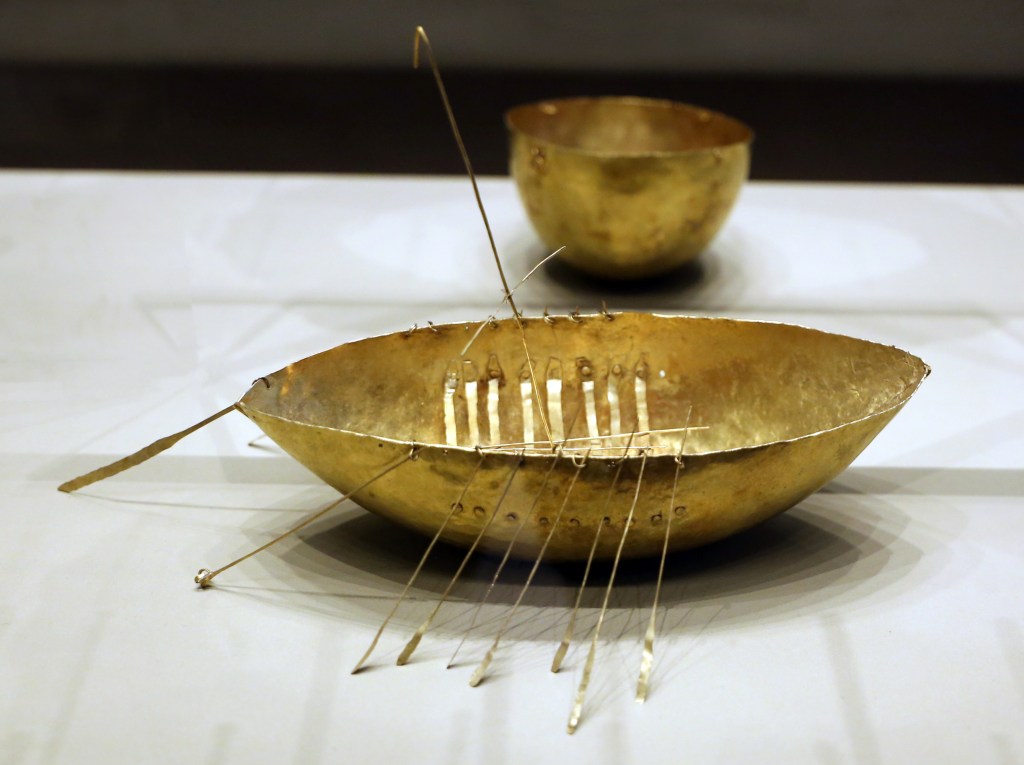

‘Manannán’s boat’ from the Broighter Gold [2]. Photo by Sailko, via wikimedia

Meeting Manannán

The next day Bran went to sea with three companies of nine men each. They headed west for two days and nights, and then they saw a chariot coming across the sea towards them carrying the sea-god Manannán mac Lir. From the chariot he sang of his strange vision of the sea around them as a flowery plain:

Bran deems it a marvellous beauty
In his coracle across the clear sea:
While to me in my chariot from afar
It is a flowery plain on which he rides about.

What is a clear sea
For the prowed skiff in which Bran is,
That is a happy plain with profusion of flowers
To me from the chariot of two wheels.

He goes on to sing about how the salmon leaping from the sea are really calves and lambs, and how Bran’s coracle is passing over a wood of beautiful fruit.

The poet and mystic John Moriarty, called these verses “the greatest theophany ever accorded to the ancient Irish. And these, the most reassuring words ever addressed to them from the Beyond. Sung to them out at sea, sung to them across the heads of the horses of Manannán, they are our Bhagavad Gita, they are our Song of God.” He goes on to explain that Manannán is showing how our world can be perceived differently, more richly through what he calls ‘silver branch’ perception. [3]
Manannán went on to sing of other things, about the heavenly qualities of his land:

We are from the beginning of creation
Without old age, without consummation of earth
Hence we expect not that there should be frailty
The sin has not come upon us.

It is a law of pride in this world
To believe in the creatures, to forget God
Overthrown by diseases, and old age,
Destruction of the soul through deception.

Manannán’s song went on to explain that he was on his way to Ireland in order to father a son who would be called Mongán mac Fiachna. Finally, Manannán ends his song:

Steadily then let Bran row
Not far to the Land of Women
Emne with many kinds of hospitality
You will reach before the setting of the sun.

The Land of Women

They rowed onwards, past the Island of Joy, until eventually they came to the Land of Women, where the Queen welcomed them from the shore. She threw a ball of thread to Bran, and as he caught it, it stuck fast to his hand, allowing the Queen to pull them into port. They stayed on the island with the women, feasting and happy, for what seemed like a year, although it was many.

Eventually one of Bran’s men called Nechtain was seized with homesickness. After a good deal of discussion, they decided that it was time to go back to Ireland, although the Queen continued to warn them against it. With sorrow, the Queen accepted their decision, but she warned them that when they returned they must not touch the land.

The Return

They left the Land of Women, and eventually they saw the shore of Ireland ahead of them, and as they came into the shallow water at Srub Brain, a crowd of local people shouted greetings to them. When Bran called out to them, saying who they were and where they had been, the people look puzzled, and then said that they had heard tales of Bran’s famous voyage, but as legends from ancient times.

Homesick and impatient, Bran’s companion Nechtain leapt from the ship onto land, but as soon as his foot touched the ground he was instantly transformed into a pile of ashes, as if he had been dead one hundred years. Bran and the rest of his companions saw that they could not return, and so Bran told the people of his wanderings, and then, bidding Ireland farewell, they set off again across the sea.

The Lough Foyle Connection

Srub Brain (‘Raven’s Headland”), where Bran and his companions make landfall, is usually identified with Inishowen Head in Donegal, by the mouth of Loch Foyle. [4] According to legend, Lough Foyle is named from Feabhal son of Lodan who belonged to the mythical Tuatha Dé Danann. [5]

The Wikipedia page on Manannán contains information about the modern statue of Manannán by Loch Foyle and the Broighter Hoard [2] which was found nearby, including a golden model of a boat thought to be a votive offering to Manannán.

John Carey, in his article on the Lough Foyle Colloquy Texts, discusses two texts associated with the legendary origin of Lough Foyle, which have a possible relationship with the Voyage of Bran. The texts both refer to a legend that Lough Foyle was part of a flooded ancient kingdom – perhaps an alternative way of looking at Manannán’s song.

The first text, The conversation of Colum Cille and the youth at Carn Eolairg, is a conversation between Saint Columba and a youth who might be Mongán mac Fiachna, the son Manannán sings of fathering when he meets Bran. Mongán speaks of Loch Foyle in the same way that Manannán talks about the sea when he meets Bran, and then seemingly the Saint and the youth spend the day talking about “the heavenly and earthly mysteries.”.

The second text, The conversation of Bran’s druid and Febul’s prophetess above Loch Febuil, is a conversation with references to rather mysterious events which perhaps come from an earlier version of Bran’s voyage, including a well (which in other legends can be an entry to the otherworld, as well as a source of flooding), a snare, and treasures of a troop of women, and the ‘stony grey sea’ where a ‘plain of white flowers’ used to be.

There’s plenty to ponder in the Voyage of Bran!


Manannán mac Lir, sculpture by John Sutton – photo by Kenneth Allen, via wikimedia

Notes:

[1] The translation I have used is by Kuno Meyer, Published 1895. The text and notes are available here: http://www.sacred-texts.com/neu/celt/vob/vob02.htm

[2] The Broighter Gold was discovered near Loch Foyle in 1896. The gold boat may have been a votive offering to Manannán Mac Lir. It is probably a model of an ocean-going vessel, of wood rather than hide-covered, complete with seats, oars, rowlocks, steering oar and mast. Currently in the National Museum, Dublin.

[3] Quote from John Moriarty’s book Nostos: An Autobiography. More about Moriarty and silver branch perception can be read here: https://celticjunction.org/cjac/arts-review/issue-12-lughnasa-2020/the-silver-branch-perception-of-john-moriarty/

[4] See https://www.logainm.ie/en/111204

[5] See https://web.archive.org/web/20180816130059/http://www.placenamesni.org/resultdetails.php?entry=17099
Once Upon a Time – the Birds of Rhiannon

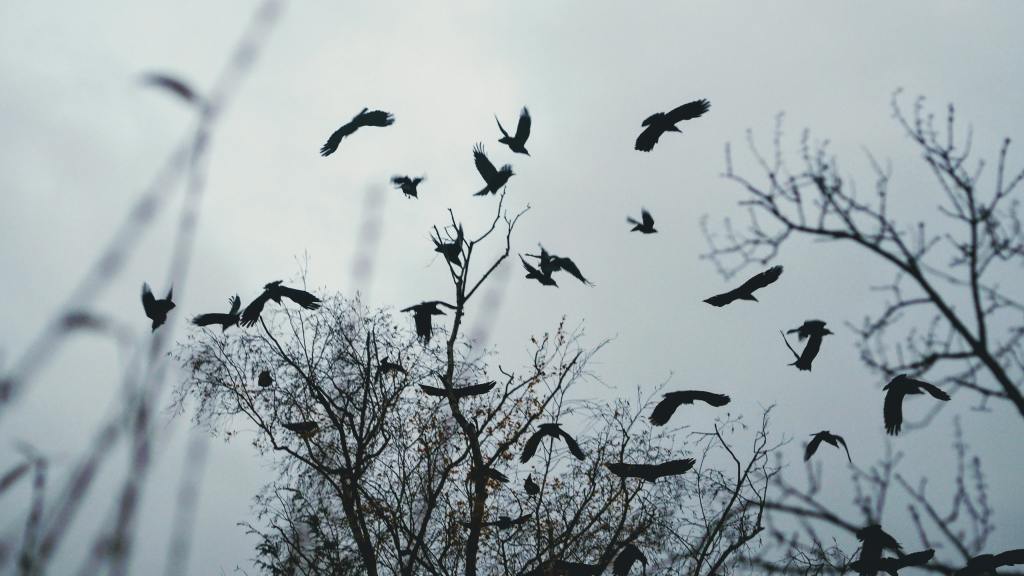
Their song can “wake the dead and lull the living to sleep”. These three legendary birds, traditionally ravens or blackbirds, are connected with Rhiannon the Queen of Dyfed who is thought to be a British horse goddess, in the Welsh mythology of The Mabinogion. Rhiannon herself possesses various magical powers, so one might expect her birds to be harbingers of her presence. Like all winged creatures the birds of Rhiannon evoke ideas of freedom from the tethers of the earth.

Timeshifters

The singing of the birds of Rhiannon also alters the passing of time – making days seem like years when in fact only a short space of time has passed. One of their other qualities is that when you hear them they can be remote but the song sounds close by, or they can sound near when they are far away, thus their song has the effect of distorting time and space, or perhaps it is vice-versa and the loss of time and space creates their song.  

In one of the stories, the chief giant Ysbaddaden sets Culhwch, our hero, a number of impossible tasks – tasks he must perform before he will bestow the gift of his daughter Olwen’s hand in marriage. One of these quests is to bring him the birds of Rhiannon, to soothe him with their magical song on the night before his death. For Ysbaddaden is doomed to die on his daughter’s wedding night and lose his kingship, so he hopes Culwhch will fail, that she might never marry, and he might live. The birds are retrieved, although the tale does not explain how. An earlier and fuller version of the tale may possibly have been lost. The birds seem to be associated with the transition time between the living and the dead, the inference being that you may hear them at this liminal time. The fact they have the power to wake the dead, or put the living to sleep speaks of their ability to draw attention to a person’s shift or change of state.

Photo by Natalia Yakovleva on Unsplash

Three Birds, Seven Years

The birds of Rhiannon are also mentioned in the second branch of the Mabinogion, in the tale of Branwen. After the war against the Irish, the fatally wounded British king orders his seven surviving men to decapitate him and take his head to the White Tower of London to bury it as a form of national protection. Are the tower ravens that still protect the Tower of London, a reminder of the protective birds of Rhiannon?

Before setting off, the seven survivors feast at Harlech for seven enchanted years, (seven often being the number of enchantment) whilst they are serenaded by the three birds of Rhiannon. Although Rhiannon’s name is not given it is likely that the three birds in this passage are the same as the ones described in Culhwch and Olwen story.

“As soon as they began to eat and drink, three birds came and sang them a song, and all the songs they had heard before were harsh compared to that one. They had to gaze far out over the sea to catch sight of the birds, yet their song was as clear as if the birds were there with them. And they feasted for seven years.’

Birdsong

The sound of birdsong is ancient, and speaks to us without language. I am reminded of the birds of Rhiannon whenever I hear the song of the blackbird in my garden. To hear the birds of Rhiannon you have to be in a place where you are free to really listen.

The birds from the trees upon the hill

announce, as they will and have since

they began to sing, the new millennia.

~

For what is new is only old tempered

by wind of changing circumstance.

~

Cry Jubilee unheard: the Lord shall

hear your song and speak it to the

wind. The birds will sing it then as now.

Bran and the British Mysteries

This is from a talk I gave some years ago about Bran the Blessed, who features in the second branch of the Mabinogion, the Tale of Branwen, daughter of Llyr

It seems to me that the story of Bran was not just put together for entertainment, and that Bran himself was more than just a fictional or half-remembered historical king. The characteristic of the old stories that interests me is their long life being passed on by word of mouth. These stories would have changed and developed as they were told generation after generation, and I think there’s a parallel here to the ‘survival of the fittest’ in evolution, so that only those stories which resonate within us survive in the long term. At some level, these stories tell a truth, which is as relevant to us now as it ever was to our ancestors.

Apart from the otherworldly nature of Bran in the story, it may well be that Bran was one of the ancient gods of Britain. As in the other stories in the Mabinogion, which were written down in Christian times, the old gods appear as kings, queens and wizards. We have to dig beneath the surface of the story to uncover some glimpses of the meaning that Bran held for the ancient Britons. My interest in doing this is not so much historical or scholarly, but to try and see what significance Bran might have for the way we live today. So what does the story of Bran tell us?

Bran’s Buried Head

Let me start from the end of the tale, where Bran’s head is buried under the white mound in London:

“And they buried the head in the White Mount, and when it was buried, this was the third goodly concealment; and it was the third ill-fated disclosure when it was disinterred, inasmuch as no invasion from across the sea came to this island while the head was in that concealment.”

Bran’s head is a clearly a guardian talisman, but it is only effective whilst it is concealed under the white mount. The disinterral mentioned was by King Arthur, who according to another legend, decided that he wanted to protect Britain by his own strength alone, and dug up the buried head, which resulted in the fall of Britain to the Saxons. This episode provides a linkage between Bran and King Arthur, both guardians of Britain, and can be read as Arthur claiming for himself the mantle of Bran. We will see further links between them later.

The idea that Bran’s head was only an effective guardian whilst it was hidden in the earth gives a hint, I think, that Bran’s power is linked to the hidden depths of the earth. In a sense, he can guard the land because burying his head makes him (and his tribe) a part of the land itself.

Traditionally, the white mount is located at the Tower of London, the central Norman white tower having been built on top the white mount. Surprising there is still an echo of Bran’s guardianship at the Tower.

I don’t know how many of you have visited the tower of London, but you may know that they keep ravens there – the only place ravens now live for hundreds of miles around. And there’s a legend about the ravens, that if they ever leave the tower, then the tower would crumble and a great disaster would befall Britain. In earlier times the ravens lived there naturally, but nowadays they clip the ravens’ wings, so they can’t fly away. The fortunes of the Tower ravens reached their lowest point after the second world war, when only a single raven remained. There is a tradition that Winston Churchill arranged that young ravens should be brought to the Tower from Wales and Scotland. In any case, the ravens were soon restored, and a complement of six birds still guard the Tower. Now the significance of the raven is that it is Bran’s totem bird. His name, Bran, is the welsh for crow or raven. So the legend of Bran’s protection of the realm still remains current, and in some sense is taken seriously, at least on a symbolic level.

How does Bran’s head come to be this protective concealed talisman?

It may be that there is an element of a sacrificed king about the tale – someone who can go ahead into the land of the dead and from there provide protection and guidance for the tribe. There are clues to this in the story. The cauldron in the tale, which was originally in Bran’s care, was clearly a gateway between life and death, the difference being that the warriors returned unable to speak, perhaps a sign that they could not profane the mysteries they had experienced. In contrast to this, as Bran lies wounded, he tells his companions what will happen to them, already seeing into the future and guiding them, and then the greatest mystery: the severed head continues to speak and takes the whole company into the otherworld for their 80 year feast. Perhaps there is a parallel between the otherworld feast, and the burial of Bran’s head. The feast comes to an end when a door is opened, just as Bran’s guardianship comes to an end when his head is revealed. These episodes portray Bran as an underworld figure, rooted in the hidden secrets of the earth, but that’s not the whole story.

Bran the Giant

Remember that Bran was a giant. In legend, Britain was first inhabited by a race of giants, and they got a very bad press as being evil, cantankerous, and rather stupid, but Bran is very different in character to your typical big, stupid giant. A giant usually represents primal, earthbound qualities, and indeed this is recalled by an earlier section of Bran’s tale. When he waded through the sea to Ireland, some swineherds saw him approaching and thought it was a mountain moving through the sea, Bran’s eyes appearing to them like lakes, and his nose a lofty ridge on the mountainside. This is the traditional earthy giant, a son of his mother the earth. And yet, in most of the tale Bran has a very different character. He is generous and wise, and usually acts as a peacemaker rather than seeking war.

Bran is a different kind of giant I think – a giant in stature rather than bulk. It was said of Bran several times in the tale that no house ever built could contain him. I don’t think this just means that he was too big to fit, but that it was a kind of need that he should always have the sky open above him, so that the earth would be under his feet, and the heavens over his head. In this way, Bran the giant could always be a link between the heavens and the earth, or more to the point, Bran was a giant because he maintained this link. I feel this connection sometimes myself – when I stand outside, feeling myself grow tall under the stars, and then imagine Bran walking across the countryside, the ground shaking at his step, but with his head way up in the night stars.

Bran is to do with the hidden and mysterious, certainly, but not just with the earth. He is connected into the unseen, he works in the domain of the invisible fields that lie above and below the middle-realm that we inhabit – our familiar world of cars and shops. Like gravity, these fields permeate and influence us – but how often are we aware of them? Can you feel the earth’s gravity now, pulling you down into the earth’s embrace? But don’t forget that it is that same gravity which rules the majestic dance of the stars and planets. Physicists today identify four primordial fields from which the whole universe was built, and the only one we can directly sense if that of gravity. These fields are a scientific paradigm of the hidden roots of the world, linking everything that exists, just as the otherworld is a more human paradigm of the hidden connection between all that lives.

To return to the Tower of London – it is a rather dark and bloody place, and one can easily imagine a sacrificed king being buried there – there have certainly been plenty of executions there over the years. But amongst the military background there is a contrasting vision – the crown jewels, which are housed there now in a rather cave-like vault. There you can see the diamonds and rubies glittering like stars, treasures taken from the depths of the earth. Again this contrast reflects the connection between the earth and the heavens, and the connecting link. Bran is guardian of these hidden treasures, and we must go into the dark to find the light.

The crown jewels are not just for rich display, but are the symbols of Britain’s sovereignty, modern-day equivalents of the thirteen sacred treasures of ancient Britain. In the coronation ceremonies, the crown jewels are used, in effect, as magical instruments to bind the monarch to the land and to the people.

Bran the Bridge

In an earlier part of the tale, Bran and his men are marching across Ireland and they come to a river where the only bridge has been destroyed by the fleeing Irishmen to stop Bran crossing after them. In a curious episode, Bran says ‘he who would be a chief, let him be a bridge,’ and then Bran lies down across the river so that his armies can march over him to the other side. This saying of Bran is quoted as if it was a common proverb, and this episode is being given as the origin of the saying.

This idea of a chief being a bridge is one worth looking into. In ancient times, part of the role of the chief of a tribe was to build and maintain relationships with neighbouring chiefs on behalf of the tribe. In effect this has carried on into modern times in the guise of a passport. In the front of my passport it says:

“Her Britannic Majesty’s Secretary of State requests and requires in the name of her Majesty all those whom it may concern to allow the bearer to pass freely without let and hindrance and to afford the bearer such assistance and protection as may be necessary.”

In this sense, the queen is acting as our bridge when we go on holiday to Spain!

There is also another aspect to this role as a bridge, which is of more interest to us. The king was supposed to build and maintain another relationship – one to the otherworld, which was considered the source of power, justice and fertility. The king was in some traditions treated as the consort of the land, and the health of the land was the responsibility of the king – bringing a literal meaning to husbandry of the land.

This link between the king and the land is most famously presented in the Arthurian legend of the Holy Grail. In this legend, there is a wounded king whose land is a wasteland, with the presumption being that it is the king’s wound that causes the wasteland. In the first part of the story, the rather naïve knight Perceval visits the wounded king and at the evening feast, the grail is carried out in procession in front of them. Despite his curiosity about the grail, Perceval asks nothing, because a nobleman friend had warned him about talking too much in polite company. The next morning the castle is deserted, and Perceval learns that his failure to ask a question about the grail had been a terrible missed opportunity to heal the king and the land.

Another tale continues the story of the grail at King Arthur’s court. The knights were all sitting at the round table when a thunderclap sounded and the grail magically appeared in the centre of the room, spreading a fragrant scent and filling each knight’s plate with their favourite food. Then the grail disappears, and King Arthur’s knights set off in quest of it.

In these stories the grail is both a means of healing and a horn of plenty, and in the later tales it is treated as a symbol of holy spirit descending to earth. Above all else, it is mysterious and holy. It is, like Bran the bridge, a link between heaven and earth, and between this world and the otherworld.

This brings us nicely back to where we started, with Arthur, having taken on Bran’s responsibility as guardian after having dug up Bran’s head, now following Bran’s advice and seeking to be a bridge in order to heal the land.

Remember

To summarise, an important part of Bran’s story is about guardianship and kingship, centred on the importance of maintaining connections between this world and the otherworld. Bran’s head can guard Britain because of his connection with the hidden depths of the earth. As a giant, Bran provides a connection between heaven and earth, and as a king he is a bridge to the otherworld.

But we shouldn’t just look on Bran as something outside ourselves, a figure of legend, perhaps telling us a little about the duty of ancient kings. I think the story is giving us clues as to how we ourselves can live a magical life.

Let’s look Bran the giant – no house could contain him. How would we apply this to ourselves? On a literal level perhaps we might spend more time outdoors, with our feet on the earth and our heads open to the sky above. This certainly would give us more opportunity for rich perception of the world around us – more food for the spirit perhaps. On another level, we are perhaps living in houses built of our habitual perceptions and thoughts, which whilst being very convenient and comfortable, may be rather limiting. Leaving this house may let us become giants as well – stretching up into the heavens, and shaking the ground as we walk!

What about Bran’s proverb on chiefdom – let him be a bridge. I think it is quite interesting here that the metaphor of a bridge is used rather than a gate or a door. We could interpret this to say that we need to maintain an open relationship with the otherworld. We should be seeking not so much to enter the otherworld, leaving this world behind, but to keep a leg in both camps, so that we can bring the riches of the otherworld through into this world. The relationship between the two is what is important.

The final clue I think is in the story of the grail: none of this is without effort. The grail may appear to us unbidden, as it did to Arthur’s knights, but it is then up to us to join the quest and go out and find it.