
The Voyage of Bran is an old Irish story in the tradition of otherworldy sea-voyages [1]. It contains clues and hints to a different way of seeing the world. Bran, a king in Ireland, is called to the otherworld by a ‘women from unknown lands’ who appears from nowhere in the middle of a feast and sings to Bran of a magical land across the western ocean. She tells him to ‘begin a voyage across the clear sea’ to reach the Land of Women. Bran sets off, and on his way he meets the Irish sea god Manannán, who sings about a strange vision of the sea around him, and about the land across the sea. Bran goes on and finally arrives at the Land of Women, where his adventures really begin!
The story was written down in the 8th century, and seems to have a connection with Lough Foyle, the estuary of the River Foyle on the north coast of Ireland.
A Woman from Unknown Lands
Bran was out walking alone and heard music behind him. As he turned about, the source of the music still remained behind him, so that he could not see it. He turned again and again, but at last the sweet music lulled him to sleep. On awakening he saw a branch of silver with white blossom lying on the ground next to him. He picked it up and took it home.
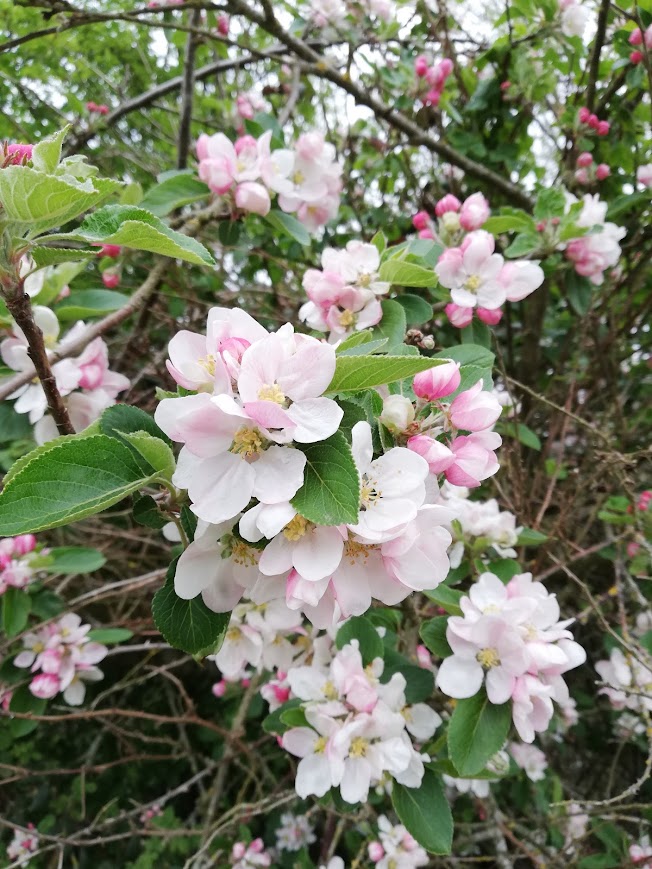
That night, as Bran was with his guests in the royal house, a woman suddenly appeared in the middle of the house, dressed in strange and rich garments. She began to sing about the apple tree of Emain (Emain Ablach is the otherworldly apple orchard – an Irish equivalent of Avalon):
A branch of the apple tree from Emain
I bring like those one knows
Twigs of white silver are on it
Crystal brows with blossom.
She goes on to sing of a paradise in the western ocean, a distant isle with happy people playing games and sport, without illness or death, but everywhere riches, beauty and joy. The verses are well worth a read.
She ended her song with a plea to Bran:
Not to all of you is my speech,
Though its great marvel has been made known:
Let Bran hear from the crowd of the world
What of wisdom has been told to him.Do not fall on a bed of sloth
Let not your intoxication overcome you
Begin a voyage across the clear sea
If perchance you may reach the Land of Women.
As she finishes her song, the silver branch that Bran was holding flew out of his hand into hers, and taking the branch with her, she leaves.
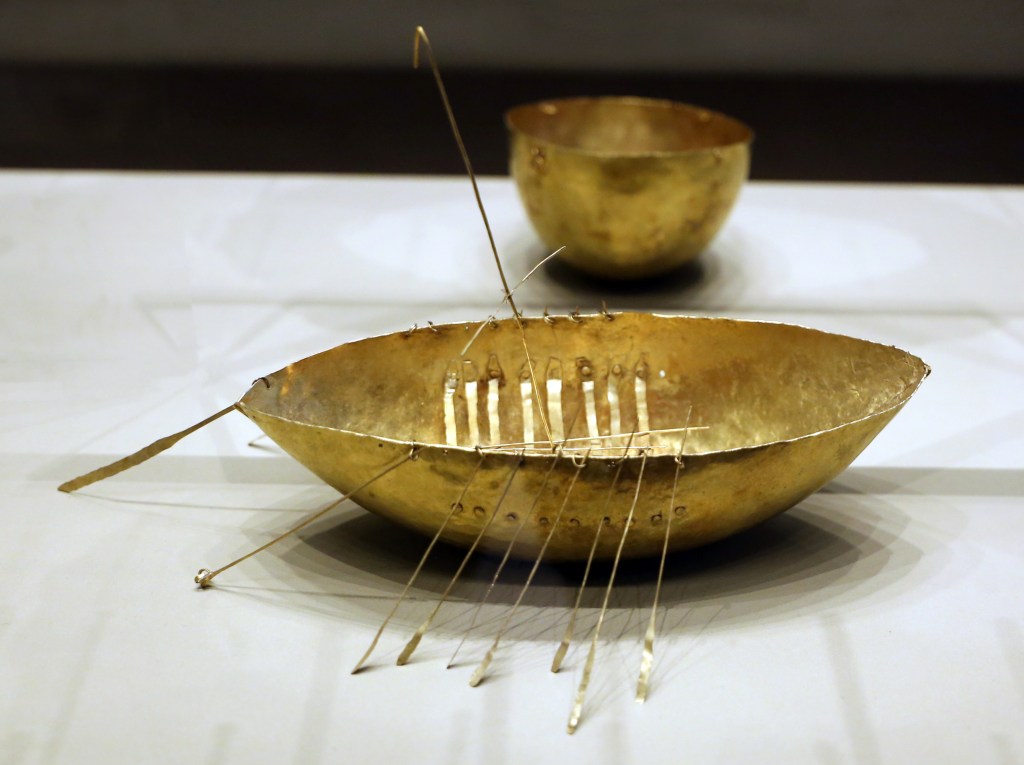
‘Manannán’s boat’ from the Broighter Gold [2]. Photo by Sailko, via wikimedia
Meeting Manannán
The next day Bran went to sea with three companies of nine men each. They headed west for two days and nights, and then they saw a chariot coming across the sea towards them carrying the sea-god Manannán mac Lir. From the chariot he sang of his strange vision of the sea around them as a flowery plain:
Bran deems it a marvellous beauty
In his coracle across the clear sea:
While to me in my chariot from afar
It is a flowery plain on which he rides about.What is a clear sea
For the prowed skiff in which Bran is,
That is a happy plain with profusion of flowers
To me from the chariot of two wheels.
He goes on to sing about how the salmon leaping from the sea are really calves and lambs, and how Bran’s coracle is passing over a wood of beautiful fruit.
The poet and mystic John Moriarty, called these verses “the greatest theophany ever accorded to the ancient Irish. And these, the most reassuring words ever addressed to them from the Beyond. Sung to them out at sea, sung to them across the heads of the horses of Manannán, they are our Bhagavad Gita, they are our Song of God.” He goes on to explain that Manannán is showing how our world can be perceived differently, more richly through what he calls ‘silver branch’ perception. [3]
Manannán went on to sing of other things, about the heavenly qualities of his land:
We are from the beginning of creation
Without old age, without consummation of earth
Hence we expect not that there should be frailty
The sin has not come upon us.…
It is a law of pride in this world
To believe in the creatures, to forget God
Overthrown by diseases, and old age,
Destruction of the soul through deception.
Manannán’s song went on to explain that he was on his way to Ireland in order to father a son who would be called Mongán mac Fiachna. Finally, Manannán ends his song:
Steadily then let Bran row
Not far to the Land of Women
Emne with many kinds of hospitality
You will reach before the setting of the sun.
The Land of Women
They rowed onwards, past the Island of Joy, until eventually they came to the Land of Women, where the Queen welcomed them from the shore. She threw a ball of thread to Bran, and as he caught it, it stuck fast to his hand, allowing the Queen to pull them into port. They stayed on the island with the women, feasting and happy, for what seemed like a year, although it was many.
Eventually one of Bran’s men called Nechtain was seized with homesickness. After a good deal of discussion, they decided that it was time to go back to Ireland, although the Queen continued to warn them against it. With sorrow, the Queen accepted their decision, but she warned them that when they returned they must not touch the land.
The Return
They left the Land of Women, and eventually they saw the shore of Ireland ahead of them, and as they came into the shallow water at Srub Brain, a crowd of local people shouted greetings to them. When Bran called out to them, saying who they were and where they had been, the people look puzzled, and then said that they had heard tales of Bran’s famous voyage, but as legends from ancient times.
Homesick and impatient, Bran’s companion Nechtain leapt from the ship onto land, but as soon as his foot touched the ground he was instantly transformed into a pile of ashes, as if he had been dead one hundred years. Bran and the rest of his companions saw that they could not return, and so Bran told the people of his wanderings, and then, bidding Ireland farewell, they set off again across the sea.
The Lough Foyle Connection
Srub Brain (‘Raven’s Headland”), where Bran and his companions make landfall, is usually identified with Inishowen Head in Donegal, by the mouth of Loch Foyle. [4] According to legend, Lough Foyle is named from Feabhal son of Lodan who belonged to the mythical Tuatha Dé Danann. [5]
The Wikipedia page on Manannán contains information about the modern statue of Manannán by Loch Foyle and the Broighter Hoard [2] which was found nearby, including a golden model of a boat thought to be a votive offering to Manannán.
John Carey, in his article on the Lough Foyle Colloquy Texts, discusses two texts associated with the legendary origin of Lough Foyle, which have a possible relationship with the Voyage of Bran. The texts both refer to a legend that Lough Foyle was part of a flooded ancient kingdom – perhaps an alternative way of looking at Manannán’s song.
The first text, The conversation of Colum Cille and the youth at Carn Eolairg, is a conversation between Saint Columba and a youth who might be Mongán mac Fiachna, the son Manannán sings of fathering when he meets Bran. Mongán speaks of Loch Foyle in the same way that Manannán talks about the sea when he meets Bran, and then seemingly the Saint and the youth spend the day talking about “the heavenly and earthly mysteries.”.
The second text, The conversation of Bran’s druid and Febul’s prophetess above Loch Febuil, is a conversation with references to rather mysterious events which perhaps come from an earlier version of Bran’s voyage, including a well (which in other legends can be an entry to the otherworld, as well as a source of flooding), a snare, and treasures of a troop of women, and the ‘stony grey sea’ where a ‘plain of white flowers’ used to be.
There’s plenty to ponder in the Voyage of Bran!

Manannán mac Lir, sculpture by John Sutton – photo by Kenneth Allen, via wikimedia
Notes:
[1] The translation I have used is by Kuno Meyer, Published 1895. The text and notes are available here: http://www.sacred-texts.com/neu/celt/vob/vob02.htm
[2] The Broighter Gold was discovered near Loch Foyle in 1896. The gold boat may have been a votive offering to Manannán Mac Lir. It is probably a model of an ocean-going vessel, of wood rather than hide-covered, complete with seats, oars, rowlocks, steering oar and mast. Currently in the National Museum, Dublin.
[3] Quote from John Moriarty’s book Nostos: An Autobiography. More about Moriarty and silver branch perception can be read here: https://celticjunction.org/cjac/arts-review/issue-12-lughnasa-2020/the-silver-branch-perception-of-john-moriarty/
[4] See https://www.logainm.ie/en/111204
[5] See https://web.archive.org/web/20180816130059/http://www.placenamesni.org/resultdetails.php?entry=17099
 Ynys Prydein - the British Mysteries